

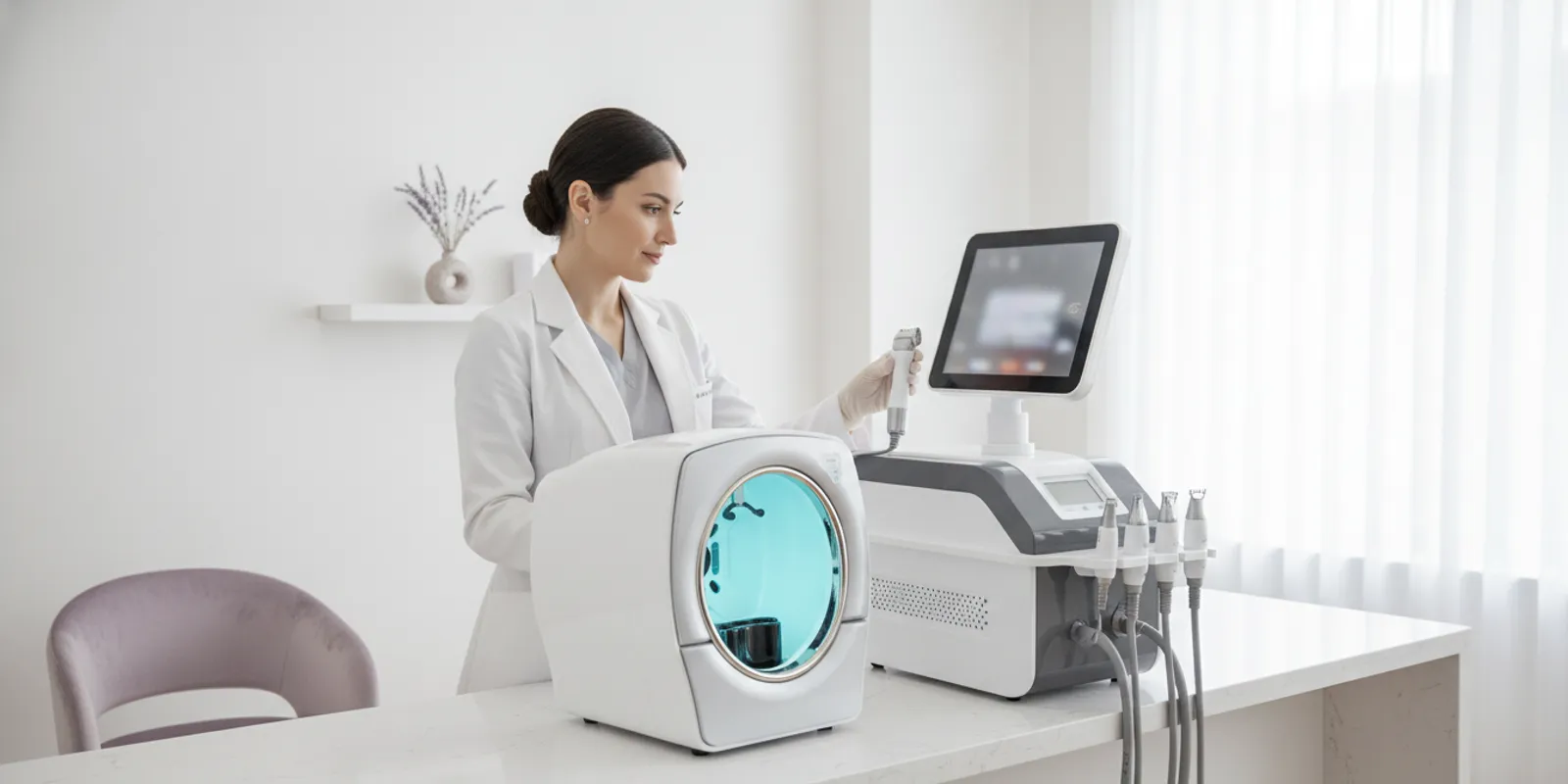
Choosing between hydradermabrasion vs microdermabrasion starts with understanding how each method exfoliates and what kind of treatment experience your practice wants to offer. Both are professional skin-care approaches that remove surface debris, but the tools, workflow, and service positioning can differ. For a practice evaluating equipment, the right choice depends on client needs, staff scope, treatment protocols, and the role the service should play in your menu.
Call to discuss professional facial equipment
What is the difference between hydradermabrasion and microdermabrasion?
Microdermabrasion exfoliates the outer skin surface through controlled mechanical abrasion. A professional device commonly uses a diamond-tip handpiece or a stream of fine crystals, along with suction to collect loosened surface material. Hydradermabrasion also exfoliates the skin, but uses a liquid-based handpiece to deliver and remove fluid during the process. Depending on the platform and its protocol, the treatment may combine exfoliation with cleansing or the application of topical solutions.
The distinction is not simply “dry” versus “wet.” Device designs and protocols vary, and both methods require appropriate operator training and client screening. A 2024 article indexed by the National Library of Medicine describes hydradermabrasion as an exfoliative cosmetic procedure for skin rejuvenation. That description helps explain the category, but does not establish that one approach is right for every client or practice. See the research article on hydradermabrasion for its discussion of the procedure.
In practical terms, compare the treatment method, consumables, setup, cleaning requirements, staff training, and fit with the rest of your services. Avoid treating marketing labels as a complete technical description. Ask the device supplier to explain exactly what the handpiece does and what the service protocol includes.
How does each treatment work?
Microdermabrasion: mechanical surface exfoliation
During microdermabrasion, the operator moves a handpiece across the treatment area using the device’s specified pressure and pattern. The abrasive surface or crystals help loosen material at the skin’s surface, while suction removes residue. The exact process depends on the device, handpiece, and manufacturer instructions.
Practices may value the straightforward mechanical concept and familiar workflow. Before selecting equipment, learn whether the platform uses replaceable tips, crystals, or another method; how the device manages collected material; and what cleaning steps follow each service. Also confirm the training and maintenance expectations rather than assuming that all microdermabrasion units operate alike.
Hydradermabrasion: exfoliation with a liquid-based workflow
Hydradermabrasion devices use a liquid flow as part of the exfoliation process. The handpiece typically moves across the skin while the system delivers fluid and removes it, with the exact sequence and available steps varying by platform. Some devices are designed as multi-modality systems, so their broader service range can include functions beyond hydradermabrasion. Review each function separately instead of assuming that every feature is part of the same treatment.
Ask what fluid or solution is used, whether the system requires proprietary or single-use supplies, how reservoirs and tubing are cleaned, and how much time staff should allow for setup and turnover. A liquid-based workflow may change how the room is prepared and how consumables are stored. The answers should come from the model’s instructions and the vendor’s training, not from a general description of the treatment category.
How do the options compare for a practice?
The table below is a starting point for a device evaluation, not a substitute for reviewing a specific product’s instructions, service requirements, or local scope rules.
| Question | Microdermabrasion | Hydradermabrasion |
|---|---|---|
| Basic method | Mechanical exfoliation, often with a diamond tip or crystals and suction | Liquid-based handpiece workflow that combines fluid delivery and removal with exfoliation |
| What varies by device? | Abrasive mechanism, tips or crystals, suction controls, and collection method | Fluid path, solution options, handpiece design, and any additional modalities |
| Supplies to investigate | Replacement tips or crystals, filters, and cleaning materials, as applicable | Solutions, filters, reservoirs or tubing care, and any device-specific supplies |
| Room and turnover questions | How to manage residue, clean the handpiece, and prepare surfaces | How to handle liquid, clean fluid-contact components, and manage waste |
| Best buying comparison | Compare the abrasion method, operator controls, maintenance, and ongoing supply needs | Compare the fluid workflow, available functions, maintenance, and ongoing supply needs |
What should you consider when selecting a treatment?
Start with the clients your practice serves and the needs your team is prepared to address. A treatment should have a clear role in the service menu. Consider whether clients are asking for a particular exfoliation experience, whether the service complements existing offerings, and whether staff can explain its purpose without promising a specific result.
- Client screening: Establish a consistent intake and consultation process. Review relevant skin history, current products, recent procedures, and any concerns that may require postponing treatment or seeking clinical guidance.
- Operator training: Confirm who may perform the treatment in your jurisdiction and what training is needed for the specific device. Make sure staff can follow the manufacturer’s instructions and your practice’s protocols.
- Protocol and customization: Ask how the device settings and steps are selected, what can be adjusted, and where the manufacturer sets limits. A flexible menu is useful only when each option has a clear protocol and trained operator.
- Consumables and cleaning: Compare recurring supplies, storage needs, cleaning steps, and maintenance. Include staff time and workflow, not only the purchase price.
- Service positioning: Decide how the treatment fits with consultation, home-care guidance, and other services. Explain what the procedure involves in plain language and avoid implying that exfoliation addresses every skin concern.
For more background on the liquid-based category, read what hydradermabrasion is. If you are planning a broader service offering, the guide to opening a medical spa can help frame operational questions beyond equipment selection.
What should buyers ask about the device?
Compare actual models rather than relying on category names. Request a demonstration that shows the complete workflow, including preparation, treatment steps, cleanup, and routine maintenance. Have the person who will operate the device participate; their questions about handpiece handling and room turnover often reveal practical differences that a product brochure will not.
- What does the device do, step by step? Ask for an explanation of each handpiece and function. For a multi-modality platform, clarify which functions are included, how they differ, and what training accompanies them.
- What supplies are needed? Request a written list of consumables and replacement parts, including any restrictions on compatible solutions. Ask how often supplies are typically replaced under the prescribed workflow.
- What is required after each client? Review handpiece disinfection, fluid-path care, waste handling, and any parts that cannot be reused. Confirm the procedure in the supplied instructions.
- What support is available? Check how training is delivered, what the warranty covers, how technical support works, and which maintenance tasks fall to the practice. Compare terms in writing.
- What is the full ownership cost? Add equipment price, supplies, maintenance, staff time, and any costs required to prepare the room. Do not assume a low initial quote means lower total operating cost.
- What client communication is appropriate? Ask what the manufacturer permits you to say about the procedure and how to describe its limitations. Your practice remains responsible for screening, informed consent, and appropriate clinical judgment.
When the equipment purchase is part of a larger operating plan, consider the practical protections discussed in questions to ask about aesthetic device insurance. Coverage terms vary, so take device details and your intended use to a qualified insurance professional.
How can a practice compare equipment demonstrations?
A useful demonstration should answer operational questions, not just show a treatment pass. Ask the supplier to walk through the manufacturer-recommended sequence from setup to end-of-service cleanup. Have the team member who expects to use the device handle the handpiece, change any tips or attachments, and review the controls. If the demonstration skips cleaning or maintenance, request those steps before deciding.
Use the same questions for every model so the comparison is fair. Record the time needed for setup and turnover, what supplies are consumed, where used materials go, and what parts need attention at the end of the day. Ask which steps require a trained operator and where the instructions prohibit substitutions. A consistent checklist can make a large feature set easier to compare.
- Does the demo reflect the exact model and handpieces being quoted?
- Can the operator explain the sequence and demonstrate all routine cleanup?
- Are consumables and replacement parts itemized with ordering details?
- What maintenance is required, and who performs it?
- Can staff receive training before offering the service?
- Which claims about the procedure are supported by product documentation?
After the demonstration, have the team summarize the workflow in its own words. If staff cannot clearly explain the service steps or the differences between settings, pause and ask for more training or written guidance. That review is not a substitute for clinical judgment; it is a practical check that the practice understands what it is buying and how it intends to use it.
What operational details affect the client experience?
Equipment choice influences more than the procedure itself. Think through the full appointment: consultation, room preparation, setup, treatment, cleanup, and follow-up communication. A treatment that fits well into the schedule should also fit the room layout and the team’s capacity. For example, a liquid-based workflow may require convenient access to solutions and a defined process for fluid-contact components. A mechanical system may require attention to its abrasive supplies and collection path. Confirm these details from the specific device instructions.
Map out the service before adding it to the booking menu. Decide how much time to reserve for consultation and treatment, who prepares the room, and how equipment is checked between clients. Identify where supplies will be stored and who monitors inventory. Consider whether the new service requires changes to consent forms, client instructions, or staff training records. These are practice-level decisions, and the appropriate process will depend on the device and local requirements.
Client-facing descriptions should be accurate and modest. Explain the method, what the appointment involves, and any relevant limits in language clients can understand. Avoid suggesting that the treatment diagnoses a condition or guarantees a result. If a client raises a medical concern, staff should follow the practice’s escalation and referral procedures rather than treating equipment selection as a substitute for evaluation.
How do you decide which approach fits your practice?
Use your practice priorities to turn the comparison into a decision. If the main goal is to add a service with a familiar mechanical exfoliation workflow, review microdermabrasion devices and their abrasive method, tips or crystals, and collection process. If you want a liquid-based exfoliation workflow, compare hydradermabrasion models by fluid handling, included steps, and maintenance. Neither category name alone tells you the exact client experience or day-to-day demands.
Then score each candidate against a short list of requirements. Separate essentials from preferences. Essentials might include suitable operator training, a manageable cleaning routine, clear documentation, and support that matches your team’s needs. Preferences could include a compact footprint, a particular handpiece design, or a broader range of functions. A simple side-by-side scorecard prevents a persuasive demonstration or a long feature list from overshadowing the needs that matter most.
Finally, review the purchase decision with the people responsible for clinical protocols, operations, and finances. Confirm the complete quoted cost and any recurring supplies. Check warranty and service terms in writing. Verify that the intended operators and planned services align with applicable rules and the manufacturer’s instructions. If important details remain unclear, ask for written answers before moving forward. This measured process helps the practice compare equipment on fit and support rather than on a single headline feature.
How does a multi-modality system fit into the comparison?
Some practices are comparing a single-purpose exfoliation device with a platform that offers hydradermabrasion alongside other functions. The Préime DermaFacial is a five-modality platform: AquaB is hydradermabrasion, Collagen Plus is radio frequency, Vibrox is carboxytherapy, Micro T is microcurrent, and UltraB is ultrasound. These are distinct modalities, and a practice should evaluate the training, protocols, and scope considerations for each one rather than treating the platform as one undifferentiated facial.
A multi-modality system may suit a practice that wants options for building varied facial protocols around one platform. That does not mean every modality belongs in every treatment, or that one device is the right fit for every business. Ask for a product demonstration, review the supplied instructions, and consider how the functions align with your team’s qualifications and the services you intend to offer. Emage Medical lists the Préime DermaFacial at $39,990; confirm current product details with the company when evaluating a purchase.
Call Emage Medical to discuss the Préime DermaFacial
Frequently Asked Questions
Is hydradermabrasion the same as microdermabrasion?
No. Both are forms of surface exfoliation, but microdermabrasion generally relies on a mechanical abrasive method, while hydradermabrasion uses a liquid-based workflow. Device designs and treatment steps vary, so compare the specific models and instructions.
Which treatment is gentler?
There is no reliable one-size-fits-all answer based on the category name alone. The device, settings, operator technique, and individual client factors matter. Practices should follow the device instructions, screen clients, and avoid promising a particular level of comfort or outcome.
Can a practice offer both treatments?
A practice may evaluate both options for its service menu, subject to applicable scope requirements, staff qualifications, device instructions, and business needs. If considering two devices, compare their distinct workflows and ongoing requirements instead of assuming that one will replace the other.
Does a hydradermabrasion device always include other facial modalities?
No. Some devices focus on hydradermabrasion, while some platforms include additional functions. Verify each included modality, its intended workflow, and the training and supplies it requires before making a buying decision.
What is the next step?
Write down the treatment goals, staff and scope requirements, workflow constraints, and ongoing costs that matter to your practice. Then compare device demonstrations against that list and verify the details in the manufacturer’s documentation. This process makes it easier to choose a treatment approach that your team can explain, operate, and support responsibly.