

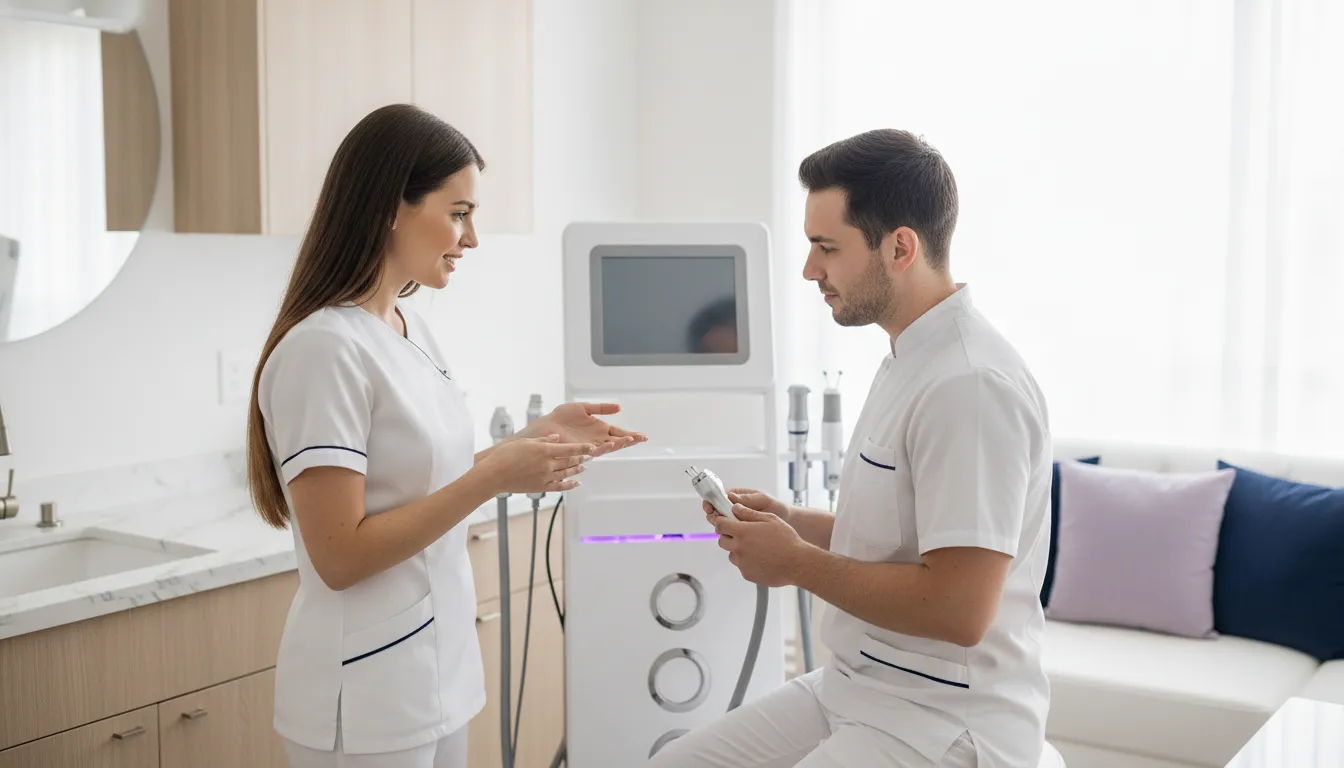
For an aesthetic practice, choosing a hydrafacial-style platform is not only a question of what happens during one facial. It also affects the protocols your team can offer and how consistently staff can follow them. Consider what data the system provides and how the equipment fits your ownership plan.
Preime DermaFacial vs HydraFacial is best understood as a comparison between a broader, five-technology platform and a more focused hydradermabrasion workflow. Preime combines hydradermabrasion, LED phototherapy, microcurrent, radiofrequency, and ultrasound in one IoT-connected system. Exact functions vary by the configuration of a traditional HydraFacial-style system. More modalities do not automatically mean better outcomes. Practices should compare protocol fit, training, consumables, connectivity, and total costs.
That distinction creates a useful starting point: first define what a single-modality service is designed to do. Then consider whether a multi-modal platform adds practical value for your providers and patients.
How Do You Compare a Preime DermaFacial vs HydraFacial Platform?
For a practice comparing Preime DermaFacial vs HydraFacial, the first question is not which name sounds more familiar. It is how each platform fits the services, protocols, and equipment strategy your team is building.
A conventional HydraFacial-style treatment generally centers on a focused hydradermabrasion workflow. Depending on the device and configuration, that may include cleansing, exfoliation, vacuum-assisted extraction, and the application of hydrating or targeted solutions. These systems can offer a recognizable, streamlined service that is relatively straightforward to add to an existing menu. Exact steps, handpieces, formulas, and treatment options vary, so practices should evaluate the specific configuration rather than assume every system performs identically.
Focused workflow or broader protocol design?
The Preime DermaFacial takes a broader platform approach. Its listed five technologies are hydradermabrasion, LED phototherapy, microcurrent, radiofrequency, and ultrasound. Providers can use the hydradermabrasion function as the foundation of a facial service, then determine whether other modalities fit the practice’s protocol, training, and client needs. The platform is also described as IoT-connected, with connectivity and real-time data delivery to providers.
That difference affects how a buyer should think about the equipment:
- Focused hydradermabrasion: a defined workflow built around cleansing, exfoliation, extraction, and solution application, with capabilities determined by the selected system.
- Multi-modal platform: a single device that brings several technology categories together, allowing a practice to design different protocols without treating the modality count as proof of better outcomes.
- Practice fit: a familiar, focused service may suit teams prioritizing simplicity, while a broader platform may suit practices seeking more treatment-planning flexibility.
For a closer look at the technologies and configuration, review the Preime DermaFacial product details. A responsible comparison should also include training, consumables, workflow time, maintenance, and the evidence supporting any claims made in patient-facing materials.
How Multi-Modal Technology Expands Treatment Planning
A broader technology set can give a practice more ways to structure a service menu, provided each modality has a clear role in the protocol. The Preime DermaFacial combines hydradermabrasion, LED, microcurrent, radiofrequency, and ultrasound in one platform. That does not establish better clinical outcomes than a HydraFacial-style system, but it can create more options for consultation-led planning.
Match each capability to the appointment plan
Hydradermabrasion uses vacuum-assisted movement to support cleansing and exfoliation within the treatment workflow. LED, including red light, can be positioned as an appearance-focused and comfort-conscious step, with vibration included among the device features. Microcurrent adds a facial toning capability that may be relevant when a provider wants to build a different type of finishing sequence. Radiofrequency operates at 1 MHz, while thermal ultrasound is also listed at 1 MHz. These specifications describe how the device is configured; they should not be presented as guarantees or as proof of superiority.
For a practice, the practical value is the ability to adjust the sequence, duration, and combination according to the consultation, provider training, and service menu. One client may receive a cleansing and exfoliation-focused protocol, while another may be evaluated for a plan that incorporates additional device capabilities. The provider remains responsible for determining appropriate use and explaining realistic appearance expectations.
Before adding a multi-modal platform, review:
- Which concerns and appointment types each modality is intended to address from an appearance and workflow perspective.
- What training, contraindication screening, documentation, and supervision your practice requires.
- Whether the treatment sequence fits room turnover, appointment length, and provider comfort.
- Which solutions, tips, and other consumables are needed for each protocol.
- How your team will explain device capabilities without promising a specific result.
This approach keeps the Preime DermaFacial product details connected to actual practice planning rather than treating a higher modality count as a standalone reason to buy.
How IoT Connectivity Changes the Operational Experience for Medspa Staff
Connectivity matters when a platform becomes part of a team’s daily treatment workflow. The Preime DermaFacial product page describes the system as IoT-connected, with global connectivity and real-time data delivery to providers. For a practice, that positions the device as more than a collection of treatment handpieces. It creates a technology layer that staff should understand before adding it to the service menu.
What staff should clarify before implementation
Real-time data delivery does not automatically establish a specific analytics package, automated recommendation system, or clinical outcome. Ask the manufacturer or distributor exactly what information the platform delivers, where records are stored, who can access them, and how the information supports your existing documentation process. The answers may affect training, privacy procedures, and how consistently providers use the device.
Protocol consistency is another operational consideration. A connected, multi-technology platform can support repeatable treatment settings, but the practice still needs clear protocols, qualified providers, and an appropriate review process. Staff should know which settings are approved for each service, how combinations are selected. And when a provider must adjust or stop a treatment based on the client assessment.
- What data is delivered in real time, and can the team review it after treatment?
- How are software updates communicated, installed, and documented?
- What training covers connectivity, device settings, records, and troubleshooting?
- Can the platform fit the practice’s existing charting, consent, and privacy procedures?
- What happens to access and workflow if connectivity is interrupted?
These questions help separate a useful operational feature from an assumed benefit. When comparing Preime DermaFacial product details with a conventional HydraFacial-style workflow, evaluate not only the treatment technologies, but also how comfortably your staff can learn, document, maintain, and use the connected platform.
What Should Practices Expect From Treatment Outcomes?
When comparing Preime DermaFacial vs HydraFacial, practices should separate what a platform is designed to do from what clinical evidence demonstrates. A device may list several technologies, adjustable settings, or a streamlined workflow. But those specifications do not by themselves prove better outcomes than a single-function or more focused system. The more useful question is whether the platform helps your providers deliver consistent protocols that match each client’s goals, skin presentation, and tolerance.
Evaluate the process behind the result
Define the appearance and experience you intend to assess. Depending on the protocol, that may include visible cleansing, hydration, radiance, skin texture, or overall client comfort. Avoid treating every modality as necessary for every appointment. A broader platform can create more options for customization, but the protocol should still be clinically appropriate, clearly documented, and delivered by trained professionals.
Use a simple evaluation framework:
- Set the baseline: Record the client’s goals, relevant history, selected protocol, settings, and provider observations.
- Standardize documentation: Use consistent lighting, camera settings, positioning, and views for before-and-after photography. Standardized, reproducible images support treatment planning and more reliable comparisons over time, as described in a review of facial aesthetic photography.
- Review the experience: Track comfort, appointment flow, repeatability, and client feedback alongside visible appearance changes.
- Refine responsibly: Compare like with like, adjust one meaningful variable at a time, and avoid presenting anecdotal improvements as proof of comparative clinical superiority.
This approach gives practices a fair basis for deciding whether modality breadth improves their service design, rather than assuming that more technologies automatically produce a better result.
Investment Comparison: Multi-Modal Platform vs Multiple Single-Function Devices
For practices comparing Preime DermaFacial vs HydraFacial, the purchase decision is broader than the equipment line item. A single-function system may fit an established, focused service, while a multi-modal platform may support a wider menu in one footprint. The right comparison is the total cost of ownership over the way your team actually delivers care.
| Factor | Multi-modal platform | Multiple single-function devices | What to verify in the quote |
|---|---|---|---|
| Footprint | One coordinated platform may simplify room planning. | Separate devices can require more floor, counter, or storage space. | Dimensions, clearance, utilities, and installation requirements. |
| Modality breadth | Preime combines hydradermabrasion, LED, microcurrent, radiofrequency, and ultrasound. | Each device may provide one or a limited set of functions. | Included handpieces, protocols, and which features are active at delivery. |
| Consumables | Ask which solutions and disposable components are recommended, and whether alternatives are permitted. | Each platform may have its own supplies and ordering requirements. | Per-treatment supply cost, minimum orders, shipping, and compatibility. |
| Fees | Confirm software, connectivity, subscription, and licensing terms. | Review the same fees for every device and software system. | One-time charges, recurring fees, upgrades, and cancellation terms. |
| Training | One platform can concentrate onboarding, but staff still need modality-specific instruction. | Training may be repeated across manufacturers and systems. | Format, duration, included sessions, travel costs, and refresher access. |
| Warranty and support | Clarify coverage for the complete platform, handpieces, software, and service response. | Coverage and response standards can differ by manufacturer. | Term, exclusions, repair logistics, loaner policy, and extension options. |
| Workflow | Combination protocols may reduce room changes and simplify treatment planning. | Moving between systems may add setup, sanitation, and documentation steps. | Cycle times, cleaning procedures, staffing, and storage workflow. |
| Scalability | Additional modalities may help a practice develop new protocols as demand changes. | Adding functions may mean another purchase, room, or training cycle. | Expansion options, software updates, accessory costs, and multi-location support. |
Review the Preime DermaFacial product details alongside Emage’s professional hydradermabrasion equipment information. Then request an itemized quote that separates equipment, consumables, financing, connectivity, training, warranty, and support. That document, matched against your projected treatment mix and available space, is more useful than a headline purchase price alone.
Which Platform Fits Your Practice?
The right choice depends less on the number of features and more on how the platform fits your practice. A focused hydrafacial-style system may suit a team that wants a familiar, streamlined service with a clear place in an established menu. A broader platform such as the Preime DermaFacial may be worth evaluating when your providers want to design protocols around hydradermabrasion, LED phototherapy, microcurrent, radiofrequency, and ultrasound.
Questions to answer before choosing
- Service menu: Which services will the device support today, and which capabilities would be genuinely used rather than left idle?
- Team and training: Who will operate it, how much training will be needed, and can your protocols remain consistent across providers?
- Room footprint: Does the equipment fit comfortably in the treatment room while leaving adequate space for staff and clients?
- Consumables and ownership: What solutions, tips, cartridges, licensing fees, warranty terms, and support arrangements should be included in your total-cost review?
- Client demand: Are clients asking for a focused cleansing and hydration service, or is there demand for a wider range of customizable aesthetic protocols?
- Documentation: Can staff document settings, protocols, and client responses in a way that supports repeatable service delivery?
- Future growth: Will the platform support your expected menu, staffing model, and space needs as the practice develops?
Ask each supplier to demonstrate the workflow your team would actually use, review current commercial terms in writing, and allow providers to assess the equipment hands-on. More modalities can expand planning options, but they do not by themselves establish better outcomes. The best fit is the system your practice can operate confidently, explain clearly, and use consistently.
Frequently Asked Questions
What is the main difference between Preime DermaFacial and HydraFacial-style treatments?
A traditional HydraFacial-style workflow typically centers on cleansing, exfoliation, infusion, and hydration, although exact functions vary by configuration. Preime DermaFacial combines hydradermabrasion with LED phototherapy, microcurrent, radiofrequency, and ultrasound in one platform, giving practices more modality options to evaluate for customized protocols.
Does having more modalities guarantee better treatment outcomes?
No. A broader technology range expands protocol and workflow options, but it does not by itself prove superior clinical or cosmetic outcomes. Practices should assess training requirements, intended use, provider technique, patient selection, documentation, and the evidence supporting each protocol before making an equipment decision.
How does connectivity affect the practice workflow?
The product is described as an IoT-connected platform with global connectivity and real-time data delivery to providers. During evaluation, ask how that information is accessed, what data is available to the team, and how it can support protocol consistency and internal review. Do not assume connectivity alone measures or guarantees results.
What should a practice compare before investing in either platform?
Compare the treatment menu, room footprint, staff training, consumables, warranty, support, financing terms, licensing or ongoing fees, and compatibility with your existing workflow. Also consider HydraFacial’s brand recognition and installed base alongside Preime DermaFacial’s broader modality range. Request current terms and a product demonstration before making a capital equipment decision.
Ready to Request a Product Tour?
A product tour can help your practice compare the Preime DermaFacial workflow, modalities, and connectivity with your current treatment approach. Request a Product Tour to discuss whether it fits your practice.