

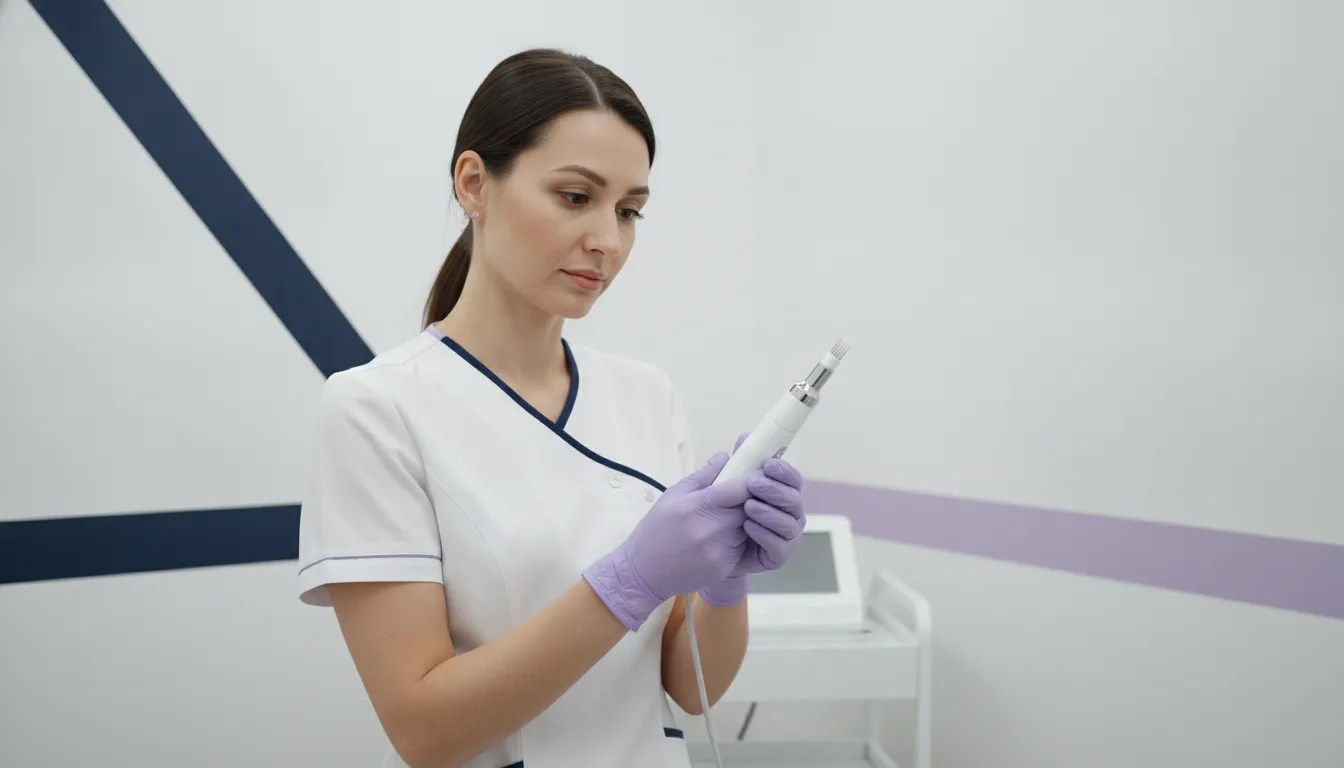
What is a professional microneedling pen, and what should an aesthetic practice evaluate before adding one? It is a clinical device, but the purchase decision is really about building a safe, repeatable service around it. The device must fit the team’s licensed workflow, intended use, infection-control procedures, training plan, and service menu.
Request a product tour to compare professional microneedling systems with your practice’s goals.
In practical terms, what is a professional microneedling pen? It is a pen-shaped medical device with needles arranged on its tip that are repeatedly inserted into and removed from the skin. The FDA notes that some motorized models allow a health care practitioner to control needle depth and speed, but clearance and authorized use remain specific to each device.
For an aesthetic practice, that distinction matters. Standard microneedling may support collagen induction and dermal remodeling, while RF microneedling is a separate technology with different capabilities. Start by understanding how a professional pen operates, then compare its controls, oversight requirements, and workflow with the limitations of at-home devices.
How Does a Professional Microneedling Pen Work vs At-Home Devices?
A professional microneedling pen is a pen-shaped device that uses a tip with multiple small needles to create controlled punctures in the skin. The FDA describes microneedling devices as instruments that repeatedly insert and remove needles, tips, or pins from the skin. In a pen-style design, the needles are arranged on the instrument tip rather than rolled across the treatment area. This format allows a licensed professional to guide the device across selected areas while maintaining a consistent clinical workflow.
Many motorized professional devices also allow the practitioner to control needle depth and speed. Those controls are device features, not a substitute for training or judgment. The appropriate approach depends on the specific device, its intended use, the treatment area, the patient’s presentation, and applicable state requirements. Practices should establish protocols through qualified clinical leadership rather than copying settings from a general article or consumer product.
Professional microneedling is commonly positioned as collagen induction therapy and dermal remodeling. Standard microneedling should also be kept distinct from RF microneedling, which adds radiofrequency energy and represents a different technology category. Practices evaluating both should compare their intended use, training requirements, consumables, and workflow separately. Explore Emage’s professional microneedling devices for product-specific information.
Where the professional workflow differs
The main distinction is not simply that one device is larger or more powerful. A professional service includes licensed oversight, patient screening, informed consent, infection-control procedures, device-specific training, and documentation. It also requires selecting a device and cartridge system that fit the practice’s service menu and staff capabilities. These responsibilities matter whether a clinic is adding its first microneedling service or replacing an existing platform.
At-home tools may appeal to consumers who want a personal skincare option, and they should not be dismissed as a single uniform category. However, they are not interchangeable with a professional medical device or a supervised treatment. Home users generally do not have the same clinical assessment, controlled environment, training, or access to device-specific protocols. A practice should communicate that difference without promising that professional treatment guarantees a particular result.
- Device control: Professional motorized pens may provide controlled depth and speed adjustments; home tools vary by design and may offer fewer controls.
- Clinical oversight: Professional services include licensed supervision, consent, screening, and infection-control obligations.
- Device selection: Practices should verify the specific product’s clearance, intended use, cartridges, training, support, and workflow fit.
In short, the value of a professional pen is the complete system around the instrument: documented device characteristics, trained operators, appropriate safeguards, and a repeatable practice workflow. The pen itself is one part of that system.
Request a product tour when you are ready to review device fit, training needs, and workflow questions with Emage Medical.
What Results Can Patients Expect from a Professional Microneedling Treatment?
Professional microneedling is best discussed as an appearance-focused treatment, not a promise of a fixed clinical outcome. A 2024 dermatology review describes microneedling, also called collagen induction therapy, as a minimally invasive procedure that creates controlled micro-injuries in the skin. The resulting healing response is associated with collagen and elastin production. Read the 2024 dermatology review on PubMed for the evidence summary and its discussion of safety and potential complications.
In practice, a qualified provider may discuss goals such as a smoother-looking skin texture, softened appearance of fine lines, or improvement in the appearance of certain scars. The same review identifies acne scars, wrinkles, hyperpigmentation, and stretch marks among the concerns studied in the literature. That does not mean every patient is an appropriate candidate, that every device is authorized for every concern, or that one treatment produces the same response for everyone.
Set goals around appearance, not guarantees
Expectation setting should account for the patient’s skin characteristics, concern, medical history, treatment plan, and healing response. Providers should also explain that visible change may develop over time as the skin’s remodeling response progresses. A professional consultation is the right place to assess candidacy, discuss realistic goals, review alternatives, and explain possible adverse effects and aftercare. It is not appropriate to promise complete correction, a particular degree of improvement, or a specific timeline.
Regulatory language matters here. The FDA has legally authorized specific microneedling devices for improving the appearance of facial acne scars, facial wrinkles, and abdominal scars in adults aged 22 or older. That authorization applies to defined devices, body areas, patient populations, and uses. It reflects FDA review of data supporting reasonable assurance of safety and effectiveness for those uses, rather than a blanket approval of all microneedling claims. Practices should match patient education and service descriptions to the device’s own labeling and intended use.
Q: Will professional microneedling guarantee better skin?
A: No. Professional equipment and licensed oversight can support a controlled, appropriate treatment process, but they cannot guarantee a result. Outcomes vary, and the evidence or authorization for one use should not be extended to unrelated conditions or individualized promises. Standard microneedling should also remain distinct from RF microneedling, which uses radiofrequency energy and has a different mechanism and risk profile.
What Is a Professional Microneedling Pen’s Depth, Speed, and Configuration?
A professional microneedling pen should be evaluated as part of a clinical workflow, not by one headline specification. Some motorized devices let the practitioner control needle depth and speed within their documented intended use. This can give the team more control. The value is not a particular number. It is whether the controls are clear, repeatable, and appropriate for the practice’s protocols and patient-assessment process.
Depth and speed are only useful when they support consistent handling. A motor that maintains a steady motion can make the device easier to manage across treatment areas, while a well-designed handpiece may reduce fatigue during a busy schedule. Ergonomics matter because grip, balance, controls, cord placement, and visibility can affect how comfortably a licensed professional works. These are workflow considerations, not substitutes for training or clinical judgment.
Cartridge design deserves the same practical review. Practices should confirm which cartridge options are available, how cartridges are packaged and changed, and whether the configuration fits the services they plan to offer. Cartridge selection should be considered alongside the device’s clearance, intended use, infection-control process, and supply continuity. Avoid assuming that a larger selection automatically means a better clinical fit.
For example, Emage identifies CytoPen NG as a professional microneedling device and lists it as FDA-cleared for medical and aesthetic use under K230420. That product-specific information is more useful for evaluation than a blanket claim about all microneedling pens. A professional buyer should verify the documentation for the exact device being considered.
Standard microneedling should also remain distinct from RF microneedling. RF systems deliver radiofrequency energy through electrodes, while a standard microneedling pen is evaluated around mechanical needle penetration and its associated workflow. They should not be compared as though they have identical mechanisms, settings, or training requirements.
Professional evaluation checklist
| Area | Question for the practice |
|---|---|
| Controls | Are depth and speed controls understandable and appropriate for documented use? |
| Handpiece | Is it balanced and comfortable for the intended workflow? |
| Cartridges | Do packaging and replacement procedures fit infection-control policies? |
| Documentation | Can the team verify clearance, intended use, training, warranty, and support? |
| Service fit | Does the configuration fit the menu without prescribing settings for individual patients? |
Microneedling is often discussed in connection with collagen induction and dermal remodeling. A 2024 dermatology review describes controlled micro-injuries and a healing response involving collagen and elastin production. Those general mechanisms do not establish a guaranteed outcome for every patient. Sound device selection keeps technology, evidence, professional oversight, and patient-specific judgment connected.
FDA Clearance and Safety Considerations for Professional Microneedling Pens
FDA clearance is not a blanket endorsement of every microneedling device, technique, treatment area, or claimed outcome. The FDA reviews and legally authorizes specific products for defined uses and body areas. Its microneedling guidance explains that the supporting data provide reasonable assurance of safety and effectiveness for those authorized uses. Practices should verify the exact device, clearance, intended use, and labeling before adding a system to a clinical workflow. FDA decision summaries and 510(k) summaries are publicly available for this purpose: review the FDA microneedling guidance.
Emage’s product materials identify two customer-specific examples. CytoPen NG is listed as a professional microneedling device that is FDA-cleared for medical and aesthetic use under K230420. CytoPen S2 is identified as FDA-cleared under K241355 and combines microneedling with microdermabrasion functionality. Those references apply to the specific products and documented uses; they should not be generalized to every professional microneedling pen or every protocol. Practices should also confirm current manufacturer documentation during procurement.
Build safety into the practice workflow
Device status is only one part of responsible implementation. A medical director or other appropriately licensed professional should confirm how applicable state scope-of-practice rules affect the service, who may perform it, and what supervision is required. The team should receive device-specific training and understand the manufacturer’s intended use, cartridge handling, cleaning and infection-control procedures, contraindication screening process, informed-consent requirements, documentation, and escalation pathway. Patient selection and treatment decisions remain matters for qualified clinical judgment, not a generic article or product page.
Support should be evaluated alongside specifications. Ask whether the supplier provides training, warranty coverage, technical assistance, and clear guidance for consumables and workflow. These details help a practice establish repeatable processes without treating a device feature as a promise of clinical results.
Do not confuse standard microneedling with RF microneedling
Standard microneedling uses needle penetration as its defining mechanism. RF microneedling is a separate technology that delivers radiofrequency energy through electrodes into and under the skin to produce local heating. The FDA has reported serious complications associated with certain RF microneedling uses and advises seeking a licensed healthcare provider with appropriate training and experience. Emage identifies Cyto-RF as a separate RF microneedling system, not a standard microneedling pen. Compare clearance, training, risks, and intended use within the correct technology category, rather than carrying assumptions from one system to another.
How to Add a Professional Microneedling Pen to Your Existing Service Menu
-
Define the service you want to add
Start with the patient needs, clinician capabilities, and appointment flow already present in your practice. Decide whether the service is intended to support a broader skin-rejuvenation menu, complement scar-focused consultations, or create a standard microneedling pathway for an existing patient population. Emage describes standard microneedling as a technology used for collagen induction therapy and dermal remodeling. Your service description should remain tied to the device’s documented intended use and your team’s professional judgment. Review the professional microneedling devices available for that role rather than starting with a generic category claim.
-
Map compliance before procurement
Confirm who may perform the service under your state and local scope-of-practice rules. Who will provide licensed oversight, and which consent, infection-control, documentation, and patient-selection processes need to be added. Verify the exact device clearance and intended use. FDA authorization applies to specific products and uses, not to every microneedling pen. For example, Emage identifies CytoPen NG as FDA-cleared for medical and aesthetic use under K230420. That product-specific information should be checked against the current manufacturer documentation before your team creates patient-facing claims or protocols.
-
Compare the device, cartridges, and workflow
Evaluate cartridge options, adjustable controls, consumable handling, setup time, cleaning responsibilities, documentation, and how the device fits the treatment room. Some motorized devices allow a practitioner to control needle depth and speed. So ask how those controls support your approved workflow without turning a marketing specification into a promised outcome. Keep standard microneedling distinct from RF microneedling. A system such as Cyto-RF is a separate RF platform with its own cartridges, depth range, and energy-delivery considerations. If dual functionality matters, Emage lists CytoPen S2 as a professional microneedling and microderm device under K241355. Compare documented capabilities, not assumptions.
-
Train the team and prepare the patient conversation
Before launch, assign training responsibilities for clinicians, room staff, and the person handling device records and consumables. Build a consultation script that explains what the service is, who should evaluate candidacy, what follow-up may involve, and which questions require a licensed professional. Avoid promising a specific result. Patient materials should also distinguish standard microneedling from RF microneedling and should use only claims supported by the selected device’s authorization and practice policies.
-
Review performance after launch
Set a review date after the first group of appointments. Assess staff workflow, cartridge use, documentation quality, patient questions, rescheduling patterns, and clinician feedback. Then decide whether the service needs revised education, additional training, or a different device configuration. A product tour can help your decision-makers evaluate fit before committing. Emage offers product tours and professional support for practices reviewing equipment, training, and implementation needs.
Request a product tour before finalizing your professional microneedling equipment shortlist.
Frequently Asked Questions
What makes a microneedling pen professional grade?
A professional device should be evaluated by its specific clearance or authorization, intended use, cartridge options, adjustable controls, workflow, training, support, warranty, and price transparency. Some motorized devices allow a practitioner to control needle depth and speed, but those controls do not replace licensed oversight, training, or professional judgment. Verify the device documentation rather than relying on a blanket category claim. FDA guidance explains that authorization applies to specific devices and uses.
How is a professional pen different from an at-home tool?
The key differences are the intended user, documented device purpose, clinical workflow, and oversight. A practice must account for state scope-of-practice rules, informed consent, infection-control procedures, staff training, and device-specific instructions. An at-home product should not be treated as equivalent to equipment selected for a licensed clinical setting.
What should a practice check before buying a professional microneedling pen?
Start with the service menu and patient population, then compare clearance, intended use. Needle or cartridge options, adjustable depth, treatment workflow, consumables, training, support, warranty, and total cost of ownership. Confirm that the device supports the services your licensed team is permitted to provide in your state. Avoid choosing based on a single specification or an unverified outcome claim.
Is RF microneedling the same as standard microneedling?
No. Standard microneedling uses needles to create controlled micro-injuries, while RF microneedling delivers radiofrequency energy through electrodes to produce local heating. They are distinct technologies with different device features, training considerations, and safety requirements. Evaluate them separately, and do not transfer a standard microneedling protocol or claim to an RF system. FDA safety guidance addresses RF microneedling specifically.
Ready to Evaluate Professional Microneedling Options?
A professional microneedling pen should fit your clinical workflow, team training, safety processes, and service menu. Review Emage Medical’s professional microneedling options and request a product tour to compare systems with your practice’s goals in mind. Explore professional microneedling options and contact the Emage team to get started.