

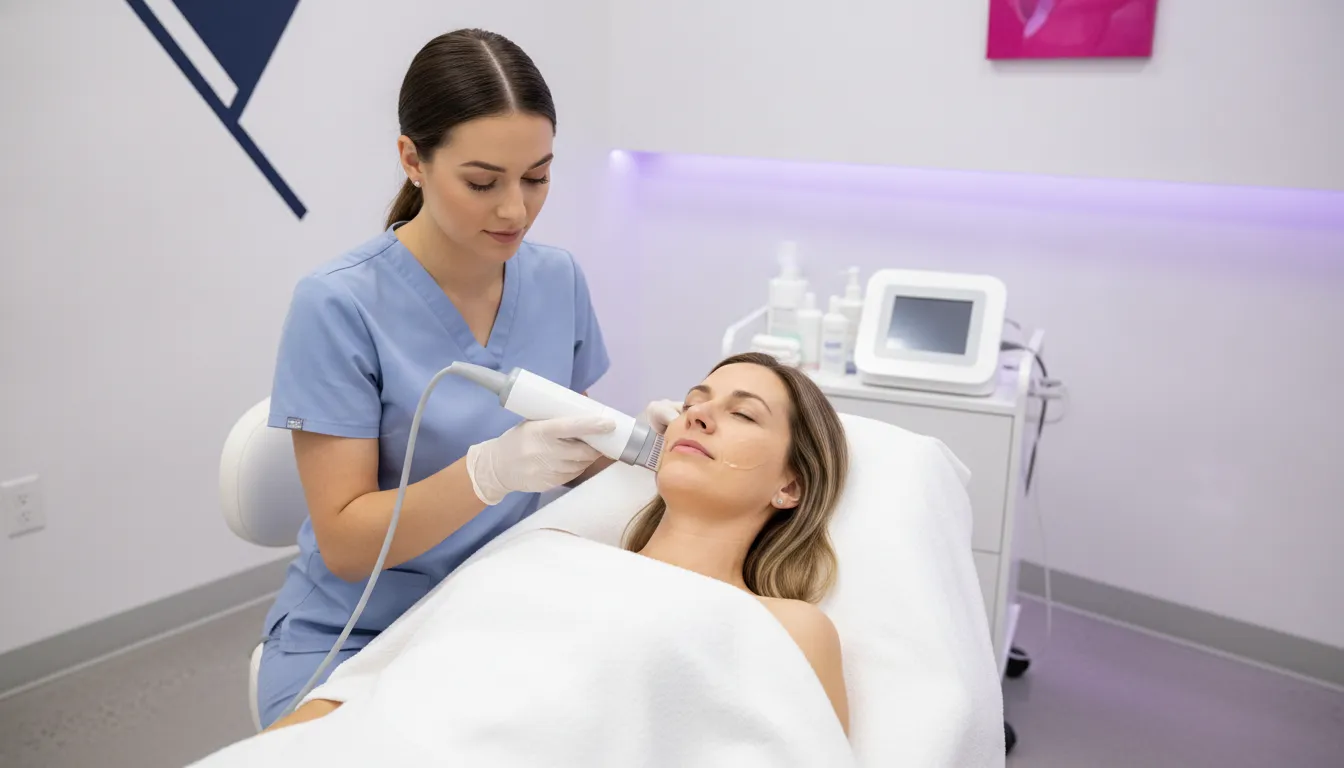
Choosing an RF microneedling machine is a practice decision, not simply a device purchase. The right platform has to fit the treatments your providers are qualified to offer, the concerns your patients ask about, the way your team documents care, and the level of training and support you need after installation. It should also give your practice a clear, responsible way to explain the technology without promising the same result for every patient.
Request a product tour to discuss RF microneedling equipment with an Emage Medical specialist.
What is an RF microneedling machine?
An RF microneedling machine combines controlled microneedle penetration with radiofrequency energy. The needles enter the skin to a selected depth, while the device delivers RF energy according to its design and settings. This differs from traditional microneedling, which relies on mechanical micro-injury without radiofrequency delivery, and from a surface-only energy treatment, which does not use needles to reach a selected tissue plane.
The practical value of the combination is flexibility. A provider can evaluate whether a patient is better served by mechanical microneedling, RF microneedling, a fractional non-ablative RF mode, or another treatment in the practice’s scope. That decision depends on the patient’s goals, skin assessment, medical history, skin condition, expectations, and the device labeling and protocol used by the practice.
RF microneedling is a professional treatment category. An aesthetic practice should use a device only through appropriately trained and licensed professionals, under the oversight required by its state and facility policies. FDA clearance is not a substitute for provider training, informed consent, screening, or compliance with applicable scope-of-practice rules.
How does RF microneedling work?
At a high level, an RF microneedling treatment has two coordinated components:
- Microneedle delivery: A cartridge uses a defined needle arrangement and adjustable penetration depth. The mechanical action creates controlled treatment points in the skin.
- Radiofrequency delivery: RF energy produces heat in tissue according to the handpiece, electrode configuration, energy level, pulse or delivery pattern, and other controls of the specific platform.
The energy is not automatically delivered in the same way by every RF microneedling machine. Some systems use insulated needles, some use non-insulated needles, and some offer multiple handpieces or modes. The provider should understand which tissue layers each mode is intended to address, what the labeling says, and what training covers before treating patients.
A 2023 review in PubMed Central’s review of radiofrequency microneedling describes the technology as a method that combines needling with radiofrequency delivery to support controlled tissue remodeling. The review also reinforces why device design, treatment parameters, patient selection, and provider technique matter. A practice should use peer-reviewed education as background, then follow the exact instructions and intended uses for its selected device.
RF microneedling compared with other treatment modes
A practice evaluating equipment should compare treatment jobs, not just marketing labels. The table below is a starting framework for a provider discussion. It is not a treatment protocol.
| Treatment mode | Primary energy or action | What the practice should evaluate |
|---|---|---|
| Traditional microneedling | Mechanical needle action | Needle configuration, depth control, handpiece ergonomics, cartridge handling, and provider training |
| RF microneedling | Microneedle delivery paired with RF energy | Energy control, delivery pattern, needle design, depth range, labeling, safety training, and workflow |
| Fractional non-ablative RF | Fractionated RF delivery without an ablative light source | How the mode differs from RF microneedling, when it is indicated, and how the provider is trained to select it |
| Laser resurfacing | Light-based energy from a specific laser platform | Wavelength, tissue interaction, downtime expectations, skin-type considerations, credentialing, and facility protocols |
These categories can overlap in a practice’s menu, but they are not interchangeable. A machine that supports more than one modality may simplify equipment planning, while it also makes training, documentation, and mode selection more important. The best platform is the one your team can use consistently and explain accurately.
Which practices benefit from evaluating RF microneedling equipment?
RF microneedling equipment may be relevant for medical spas, dermatology practices, plastic surgery practices, and other aesthetic clinics operating with appropriate medical oversight. The decision should start with the practice’s service strategy rather than a competitor’s device list.
Medspas adding a higher-value treatment category
A medspa may evaluate RF microneedling when patients are asking for options related to texture, laxity, scars, or visible signs of skin aging. Before adding the service, the owner and medical director should define the intended patient population, provider qualifications, consultation process, consumables plan, and follow-up standard.
Dermatology and plastic surgery practices expanding nonsurgical care
Established medical practices may already have consultation, photography, consent, and follow-up systems in place. For these practices, the equipment question often centers on how RF microneedling fits alongside existing procedures, how providers will document the selected mode, and whether the platform creates a manageable training and service path.
Practices upgrading from traditional microneedling
An existing microneedling service does not automatically mean an RF platform is the right upgrade. Compare the new device’s intended use, needle and energy controls, patient-screening requirements, consumable workflow, cleaning procedures, service coverage, and total operational burden. An upgrade should solve a defined practice need, not simply add a longer feature list.
What should buyers look for in an RF microneedling machine?
Professional buyers should assess the complete system. A lower purchase price or an impressive energy specification cannot compensate for a poor fit with the practice’s providers, treatment room, patient flow, or support needs.
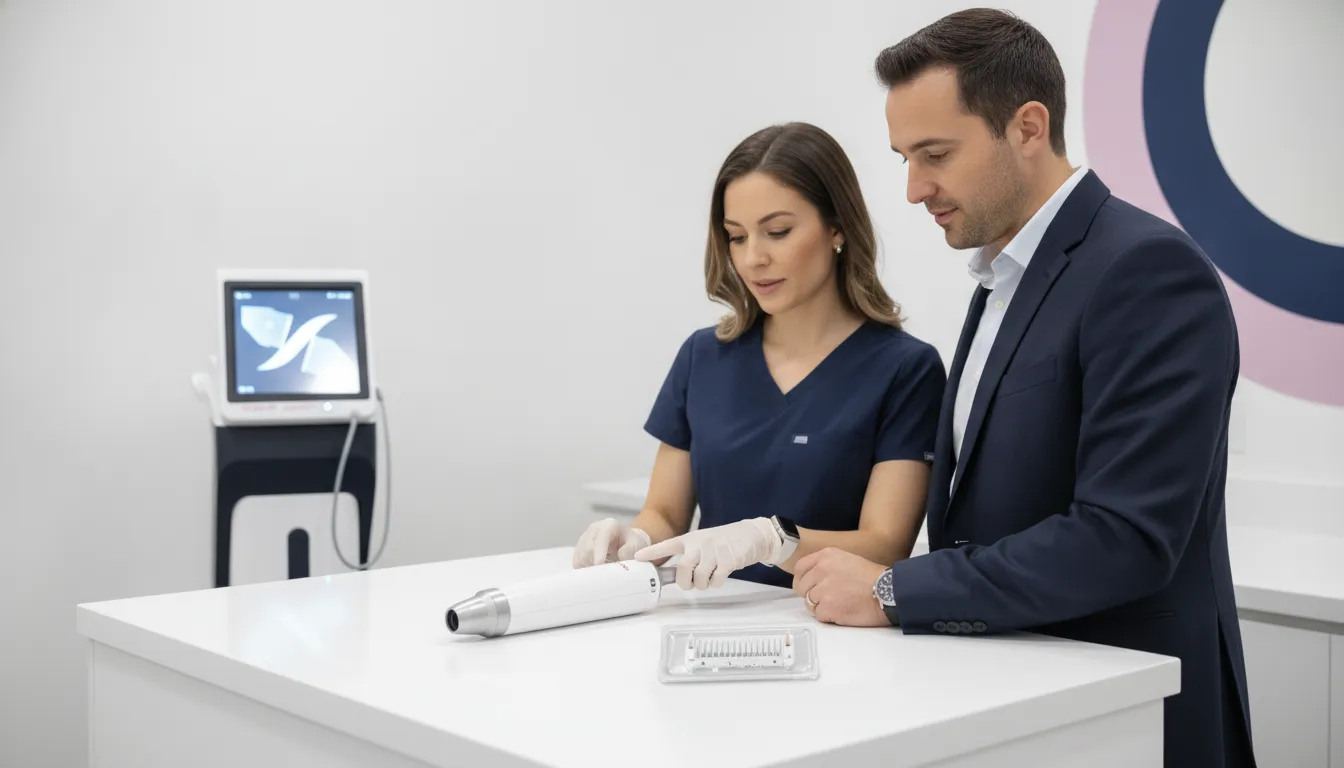
1. Clear device identity and intended use
Start with the device’s regulatory status and intended use. The FDA medical device resources explain the difference between regulatory pathways and why buyers should review the specific device documentation rather than relying on broad phrases such as FDA approved. Ask the manufacturer for the relevant clearance information, labeling, contraindications, warnings, and instructions for use.
For Emage Medical’s Cyto-RF, the company identifies FDA clearance K231749 and describes the platform as combining RF microneedling with fractional non-ablative RF. The FDA 510(k) summary for K231749 identifies the cleared device as a Sincoheren Radio Frequency System and describes its intended use for electrocoagulation and hemostasis in dermatologic and general surgical procedures. Buyers should reconcile that regulatory record with the current Cyto-RF labeling and instructions for use, and should not assume that every marketing statement, mode, configuration, or treatment claim is covered without device-specific documentation.
2. Needle configuration and depth control
Needle count, cartridge configuration, insulation, insertion method, and depth range influence how the provider plans a treatment. Buyers should ask:
- Which needle cartridges are available, and what is each designed to do?
- How is the selected depth controlled and displayed?
- Does the handpiece provide the feedback the provider needs?
- How are single-use cartridges packaged, stored, tracked, and discarded?
- What documentation supports the available settings and modes?
More options are useful only when the team understands them. A platform with a narrow but well-supported set of configurations can be more practical than one with controls that staff rarely use confidently.
3. RF control and delivery consistency
Look beyond a maximum wattage number. Ask how the machine controls RF frequency, energy, timing, delivery pattern, and feedback. The important question is whether trained providers can reproduce an appropriate treatment plan within the device’s labeling and the practice’s protocols.
For example, Emage lists a 1 MHz RF frequency and output up to 50 W for Cyto-RF. These are specifications to evaluate alongside the handpiece design, cartridge options, controls, training, and instructions for use. A specification on its own does not establish the right setting for a particular patient or concern.
4. Handpiece ergonomics and room workflow
Providers use a handpiece repeatedly during a treatment, so balance, cable management, trigger controls, foot-pedal operation, touchscreen placement, and access to consumables all matter. Have the actual users handle the equipment during a demonstration. A product tour should answer how the device moves through a treatment, not only show a brochure.
Also consider the room footprint, electrical requirements, surface cleaning, storage, cartridge preparation, waste handling, and the steps required between patients. Workflow friction becomes expensive when a service is performed several times each week.
5. Safety, screening, and documentation support
A responsible vendor should make it easy for the practice to identify warnings, contraindications, precautions, maintenance requirements, and training expectations. The practice should be able to build a consistent screening and consent workflow without turning a sales conversation into medical advice.
Ask whether the manufacturer supplies training materials, operator education, service documentation, and a reliable way to ask technical questions. The provider remains responsible for clinical decisions, but a clear support system can reduce preventable operational errors.
How should a practice screen and prepare for RF microneedling?
The exact screening and treatment protocol belongs to a qualified provider and must follow the device instructions and local requirements. From an operations perspective, the practice should establish a repeatable process before the first appointment.
- Consultation: Document the patient’s goals, relevant history, current products or treatments, and expectations. Determine whether the concern is appropriate for the service or needs another evaluation.
- Skin assessment: Record the findings that influence treatment selection and document why the chosen modality is appropriate. Consistent photography can improve consultations and follow-up conversations.
- Informed consent: Review the intended treatment, expected recovery, possible risks, alternatives, and aftercare requirements in language the patient can understand.
- Room and device preparation: Confirm that the treatment room, handpiece, cartridge, protective supplies, and documentation are ready before the patient is positioned.
- Provider-led treatment: Use the device only as trained and according to its labeling, the practice protocol, and the provider’s scope of practice.
- Aftercare and follow-up: Give written aftercare instructions, document the treatment, and set expectations for follow-up. Record questions or concerns that require provider review.
Medical spa owners often focus on the treatment itself and underestimate the consultation and follow-up system. In practice, those touchpoints influence patient confidence, rebooking, referrals, and the quality of the record.
What training and support should come with the equipment?
Training is part of the equipment purchase. A provider should know the machine’s controls, cartridge options, energy delivery, safety information, cleaning and maintenance expectations, documentation process, and escalation path for technical questions.
Ask vendors to explain:
- Who conducts initial training and whether the training is live, remote, in person, or a combination.
- Whether new employees can receive training after the initial installation.
- What the warranty covers, what it excludes, and how service requests are handled.
- Whether support is available during the practice’s operating hours and how urgent issues are escalated.
- How software updates, handpiece service, replacement parts, and consumables are managed.
- What marketing or consultation resources are available, and whether the practice can use them without making unsupported claims.
Emage Medical describes its support model as including training and ongoing guidance, and its current Cyto-RF product page states that customers receive an industry-leading two-year warranty. Buyers should confirm the current warranty terms, exclusions, and service response process in writing, then compare that commitment with the expected life of the device.
Review Emage Medical’s marketing and practice support resources before you compare vendors.
How does an RF microneedling machine fit into a practice workflow?
A machine earns its place when the full patient journey is manageable. Map the service from the first inquiry through follow-up before committing to equipment.
Build a consultation that explains the technology
Patients may use the phrase RF microneedling to describe several different devices and treatment experiences. Your consultation should explain what your selected platform does, what it does not do, how the provider chooses a mode, and what the patient should expect during recovery. Avoid absolute promises and before-and-after language that implies a guaranteed result.
Use imaging to improve the conversation
Standardized photographs or a professional skin imaging system can help providers discuss visible concerns and establish a baseline. Emage’s skin imaging systems are designed for professional consultation and documentation. If your practice uses imaging, create a consistent process for lighting, positioning, consent, storage, and follow-up comparisons.
Define responsibilities by role
Clarify who handles the inquiry, consultation, screening, consent, treatment, photography, checkout, aftercare, and follow-up. A practice manager may own inventory and scheduling, while the medical director defines oversight and the treating provider makes patient-specific decisions. Clear ownership prevents gaps when the service becomes busy.
Track operational metrics before making revenue claims
Track consultations, completed treatments, cancellations, consumable use, rebooking, follow-up completion, patient questions, and service downtime. These measures show whether the service is operationally healthy. They are more useful than copying a vendor’s revenue example because they reflect your actual staffing, pricing, demand, and patient experience.
How can practices compare an RF microneedling machine without overpaying?
Compare the total ownership picture instead of comparing only the device price. A useful buyer worksheet includes:
| Category | Questions to ask |
|---|---|
| Clinical fit | Does the device’s intended use match the services and patient population the practice is qualified to serve? |
| Provider fit | Can the intended users complete training and use the controls consistently? |
| Workflow fit | Can the room, schedule, consumables, cleaning, documentation, and follow-up support the service? |
| Financial fit | What are the equipment, cartridge, service, training, financing, and downtime costs over the planned ownership period? |
| Vendor fit | Can the manufacturer provide responsive technical help, clear warranty terms, and usable practice-development resources? |
Do not treat financing as proof that a device is affordable for your practice. Review the full agreement, payment obligations, consumables, service costs, and expected use. Emage Medical provides a financing information page for practices evaluating payment options. A representative can explain which options apply to a specific purchase.
Compare Cyto-RF specifications, modes, and support details with the requirements on your buyer worksheet.
What does total ownership look like?
The purchase agreement is only one part of the financial decision. A realistic equipment review accounts for the costs and resources required to operate the service safely over time. Include the machine, financing charges if applicable, single-use cartridges, treatment-room supplies, maintenance, staff training time, software or service terms, downtime, marketing, and follow-up administration. The practice should also consider whether it needs imaging, additional storage, or changes to its scheduling and consent process.
Separate fixed costs from variable costs. A warranty may reduce the risk of an unexpected repair, while consumables and staff time recur with each treatment. Ask the vendor how cartridges are ordered, whether availability can change, how replacement parts are handled, and what happens when the machine is being serviced. These questions are not objections to the purchase. They are part of protecting patient continuity and setting responsible operating targets.
Do not build the business case around a guaranteed number of treatments, a quoted return, or an assumed price. Instead, model conservative, expected, and high-demand scenarios using the practice’s own consultation volume, staffing, treatment capacity, consumable requirements, and approved fee schedule. Then review the assumptions with the people responsible for clinical oversight and finance.
A simple implementation-readiness audit
- Demand: Can the practice identify a genuine patient need from consultations, existing services, or documented inquiry patterns?
- People: Are the medical director, providers, and operations team aligned on training, scope, scheduling, and follow-up?
- Place: Is the treatment room ready for the machine, storage, cleaning, consent, privacy, and waste workflow?
- Process: Are screening, informed consent, documentation, aftercare, escalation, and quality-review steps written before launch?
- Partner: Has the vendor clearly documented support, warranty, consumables, service, and the process for technical questions?
If one of these answers is no, the practice may need preparation before purchase. That is a useful finding, not a failed equipment search. A defined readiness gap gives the owner a better next step and helps prevent a new machine from sitting unused.
Revisit the audit after the demonstration and again before launch. The equipment decision should be documented alongside the provider training record, approved protocols, and the service plan so that growth does not outpace the practice’s ability to deliver a consistent experience.
What makes a dual-modality platform worth considering?
A dual-modality platform can be useful when a practice wants more than one RF treatment approach without purchasing separate systems. The benefit is not the word dual by itself. The benefit is whether the available modes solve real patient and workflow needs while the team can learn and document them properly.
Emage describes Cyto-RF as combining RF microneedling with fractional non-ablative RF in one platform. The company also lists adjustable depths from 0.25 mm to 3.5 mm, 25-pin, 49-pin, and 49 RF cartridges, a 15-inch LCD touchscreen, and control through a foot pedal or handle trigger. These features may help a practice evaluate flexibility and ergonomics, but the provider must still select the appropriate mode and settings within the device labeling and professional standard of care.
One platform may also simplify onboarding, maintenance, room allocation, and vendor communication. On the other hand, a system with multiple modes requires a stronger training plan. Before buying, ask the vendor to demonstrate how the modes differ, how the team records the selected mode, and how technical support handles questions after training.
RF microneedling safety and responsible marketing
Safety starts with the provider, the device labeling, the practice’s policies, and patient selection. A website article cannot determine whether a treatment is appropriate for a particular patient. Practices should build their protocols with qualified medical leadership and review applicable state and facility requirements.
Responsible marketing should:
- Describe the technology and intended use accurately.
- Use FDA-cleared language only when it applies to the exact device and intended use.
- Avoid guarantees, universal results, or claims that a treatment is risk-free.
- Set realistic expectations about the consultation, treatment experience, recovery, and follow-up.
- Use consented photography and avoid implying that one patient’s result is typical for everyone.
- Direct medical questions to a qualified provider rather than answering them with sales copy.
This standard protects patients and supports long-term trust. It also gives the sales team a more credible way to discuss why the practice selected its equipment.
Questions to ask during an RF microneedling equipment demonstration
Bring the people who will actually use and support the machine to the demonstration. Ask the vendor to show the complete experience, from setup through post-treatment documentation.
- What is the device cleared or indicated to do, and where can we review the current instructions for use?
- How do the microneedling and RF modes differ in delivery, controls, and training requirements?
- What needle cartridges are available, and how are they ordered, stored, tracked, and discarded?
- How are depth and energy selected and confirmed before treatment?
- What does onboarding include for the medical director, treating providers, and new staff?
- What happens when the device needs service or a handpiece is unavailable?
- What warranty, support, training, and practice-development resources are included?
- Can we speak with an experienced practice about its implementation process without relying on an unsupported outcome promise?
The quality of the answers matters as much as the feature list. A vendor that can explain limitations, training, and support clearly is more likely to be a useful long-term partner.
When should a practice choose RF microneedling?
RF microneedling may be worth evaluating when a practice has a defined patient need, qualified providers, appropriate oversight, a repeatable consultation process, and enough operational capacity to support follow-up. It is not a shortcut around screening or clinical judgment, and it is not automatically the best answer for every skin concern.
Begin with a written business case:
- Define the patient concerns and service gaps the equipment is expected to address.
- List the providers who will use it and verify training and scope requirements.
- Map the room, schedule, consumables, consent, documentation, and follow-up workflow.
- Compare the device’s intended use, controls, support, warranty, and total ownership costs.
- Set measurable operating targets without promising a specific clinical or financial outcome.
- Review the plan with the practice’s medical and financial decision-makers before signing.
This process helps a practice choose equipment that can be used responsibly and consistently, rather than buying a machine that looks impressive but does not fit the organization.
Frequently asked questions
Is RF microneedling appropriate for every patient?
No. Appropriateness depends on the patient’s goals, history, skin assessment, expectations, and the selected device’s labeling. A qualified provider must screen the patient and decide whether the treatment is suitable.
What is the difference between RF microneedling and traditional microneedling?
Traditional microneedling uses mechanical needle action. RF microneedling adds radiofrequency delivery through or around the needles, depending on the device design. Providers should compare the exact platform, labeling, and training rather than assuming all systems work the same way.
How should a practice choose between RF microneedling and laser resurfacing?
Compare the patient’s goals, the device’s intended use, provider qualifications, skin-type considerations, expected recovery, room workflow, and practice protocols. A qualified provider should make the patient-specific treatment decision.
What should be included with an RF microneedling machine?
In addition to the device, evaluate cartridges or other consumables, training, instructions for use, safety information, maintenance, warranty coverage, technical support, and documentation resources. Confirm each item and its current terms with the manufacturer.
Can an RF microneedling machine be used in a medspa?
It may be used in a medspa when the facility has the required medical oversight, appropriately trained providers, and processes that comply with applicable laws, regulations, device labeling, and facility policies. Requirements vary by location, so the practice should verify them before offering the service.
Bottom line for professional buyers
The best RF microneedling machine for an aesthetic practice is the one that matches the practice’s qualified services, provider skill level, patient journey, room workflow, documentation standards, and long-term support needs. Evaluate the full system: device identity, intended use, needle and RF controls, training, consumables, service, warranty, financing, and responsible marketing.
Emage Medical’s Cyto-RF is one example of a dual-modality platform designed for professional practices. The next step is not to accept a feature list at face value. Use a product tour to ask focused questions, compare the platform with your written requirements, and determine whether the equipment supports the kind of patient experience and practice growth you want to build.
Request a product tour with Emage Medical to review your practice’s RF microneedling equipment needs.
Professional use note: This article is educational and does not provide medical advice or a patient-specific treatment recommendation. Follow the selected device’s current labeling and instructions for use, applicable laws and regulations, facility policies, and the judgment of qualified medical professionals.