

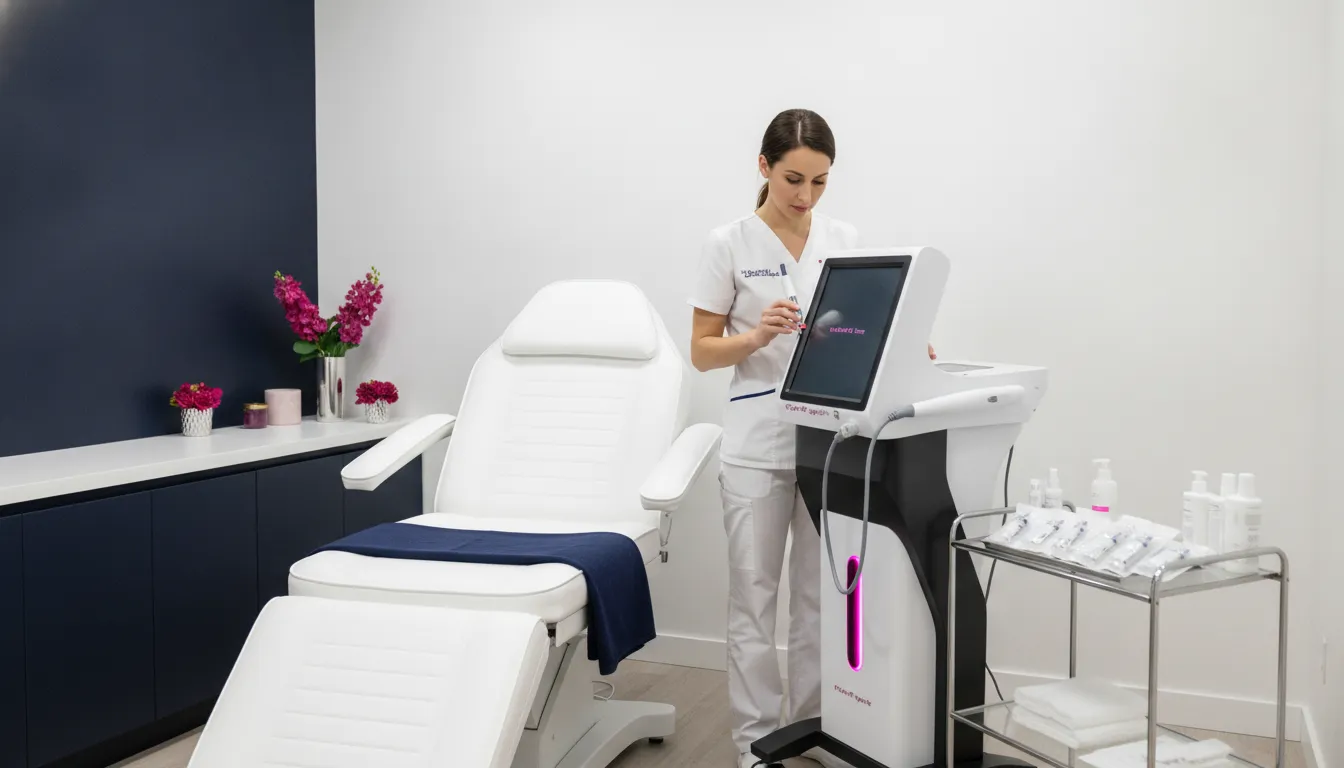
Adding microneedling is not simply a matter of placing a new device in an open treatment room. A successful launch connects clinical oversight, provider training, patient screening, room workflow, documentation, and a service model your team can deliver consistently.
Request a product tour to evaluate a professional microneedling platform for your practice.
To add professional microneedling services responsibly, first confirm medical supervision and state scope-of-practice requirements. Next, define the patients and concerns you intend to serve. Then select a platform that fits those goals and build protocols for consultation, treatment, infection control, and aftercare before promoting the service.
Microneedling is a medical procedure, and the American Academy of Dermatology recommends qualified medical evaluation to determine whether it is appropriate for a patient. That makes implementation as important as equipment selection. This guide outlines how to evaluate readiness, compare standard and RF approaches at a high level, and create a practical patient experience. It is designed for practices considering a general microneedling service launch.
Its scope is intentionally distinct from an RF-specific launch guide. This article covers the general operational framework for adding standard professional microneedling, including governance, screening, workflow, economics, and patient education. RF-specific device selection, treatment parameters, and RF economics belong in a separate RF microneedling resource. Keeping those boundaries clear helps a practice find the right information without treating two related services as one decision.
How to Add Professional Microneedling Services Responsibly
Adding professional microneedling services is a clinical and operational decision, not simply an equipment purchase. Before building the service menu, confirm who will provide medical oversight. Identify which licensed professionals may perform the procedure. Confirm what your state requires for delegation, supervision, documentation, and infection control. Requirements vary, so review the plan with your medical director, the applicable state board, and qualified compliance counsel. This article is educational, not legal advice.
Confirm oversight and scope of practice first
Microneedling is a medical procedure, and responsible implementation starts with a written governance plan. Identify the supervising clinician, define provider responsibilities, and document how consultations, treatment protocols, adverse-event escalation, and follow-up will be handled. Each provider should work within the scope allowed by the provider’s license, training, and state rules. Do not assume that a protocol permitted in one state can be transferred to another. A device clearance also does not determine who may operate the device in every jurisdiction.
Have the medical director and compliance team review patient-facing language before launch. Claims should describe the service accurately without promising a particular result. Depending on the patient’s concern, microneedling may be considered for issues such as acne scars, fine lines, uneven tone, or stretch marks. Suitability and treatment planning still require professional judgment. The American Academy of Dermatology recommends a medical evaluation to determine whether microneedling is appropriate for a patient’s condition. Review the AAD patient guidance as part of your clinical education process.
Build a patient-selection and readiness checklist
Use a documented consultation and screening process before scheduling treatment. Capture the patient’s goals, health history, medications, prior procedures, skin assessment, and expectations. The clinician should determine whether the patient is an appropriate candidate and record the rationale. A screening conversation should not be reduced to a checkbox or delegated to a marketing team.
- Confirm medical oversight, provider credentials, and state scope-of-practice requirements.
- Approve protocols for consultation, consent, treatment, infection control, aftercare, and escalation.
- Define screening criteria, contraindications, referral triggers, and follow-up procedures.
- Train staff on the selected platform and verify competency before independent treatment.
- Audit documentation and patient communications before promoting the service publicly.
The AAD notes that people who heal poorly, have a history of keloids, or have a weakened immune system may not be appropriate candidates. Active skin infection, recent tanning, painful or deep acne, and current or recent isotretinoin use may also require delaying treatment. The clinician should make the final determination, explain the reasoning, and document the plan.
Choosing a Microneedling Platform for Your Practice Model
The right platform is the one that fits the service your practice can responsibly deliver, not simply the device with the longest feature list. Start by defining the role microneedling will play in your service menu. A practice focused on collagen induction and skin texture may need a different workflow from a practice that intends to combine microneedling with other modalities. Clarify the patient population, provider experience, appointment length, treatment areas, and expected volume before comparing systems.
Compare standard microneedling with the right questions
When evaluating a standard professional microneedling platform, ask questions that connect the equipment to daily care. Review how the device is prepared, adjusted, cleaned, stored, and documented. Confirm which components are single-use, what the manufacturer requires for safe operation, and how the practice will track device and cartridge information. Training should address more than button presses. It should support provider competency, treatment planning, patient communication, and escalation.
Emage Medical’s professional microneedling technology overview can help practices begin that evaluation. Use a product page as a starting point for questions, then confirm current specifications, training, warranty, and support terms directly with the manufacturer. Do not treat a feature list as a substitute for medical oversight or a practice-specific protocol.
Keep the RF decision separate
RF microneedling is a related but distinct service category. It combines microneedling with radiofrequency energy, so its evaluation requires additional questions about energy delivery, indications, provider training, patient selection, treatment protocols, and aftercare. The Cleveland Clinic provides a neutral explanation of the RF microneedling concept in its RF microneedling overview.
For this general launch guide, the boundary is practical: choose the standard microneedling workflow when that is the service under consideration. If the practice is deciding whether to add RF energy, pause the general equipment comparison and use an RF-specific evaluation process. Avoid presenting standard and RF systems as interchangeable or promising that one modality is appropriate for every patient.
| Evaluation area. | Standard microneedling launch. | RF microneedling launch. |
|---|---|---|
| Primary planning focus. | Provider scope, screening, cartridge workflow, documentation, and aftercare. | All standard requirements, plus energy delivery, RF-specific protocols, and additional training. |
| Equipment questions. | Preparation, depth or setting controls, single-use components, cleaning, and storage. | Those same questions, plus RF delivery, safety controls, and manufacturer-specific operating requirements. |
| Content boundary for this guide. | Covered as the general service-launch framework. | Requires a separate RF-specific evaluation before purchase or promotion. |
Evaluate support as part of the equipment decision
Ask how the manufacturer supports implementation after delivery. Review the training format, available technical support, warranty terms, consumable ordering process, and documentation resources. Confirm whether staff can obtain help when a workflow question arises. Emage Medical provides professional aesthetic equipment and positions training and support as part of its practice relationship. Verify the current terms for the specific platform and purchase arrangement before representing them in patient-facing materials.
Build the Treatment Room and Patient Workflow Before Launch
A service can be clinically appropriate and still fail operationally if the room, schedule, and documentation process are not ready. Map the patient experience from the first inquiry through follow-up. Assign ownership for each step so the team understands who performs the work and when.
Start with clinical readiness
Before the first appointment, approve the consultation script, screening form, consent language, treatment protocol, aftercare instructions, and escalation pathway. Verify that required supplies are available. Establish a room setup and turnover checklist that covers hand hygiene, clean surfaces, personal protective equipment, single-use components where required, sharps disposal, and safe storage. Follow the manufacturer’s instructions and the practice’s infection-control policy for every treatment.
Keep clinical decisions with qualified professionals. Front-desk staff can explain the scheduling process and collect basic information, but they should not determine candidacy, promise an outcome, or answer questions outside their training. Build a clear handoff to the clinician when a patient reports a health condition, medication, prior procedure, or concern that requires review.
Map each patient touchpoint
- Inquiry and education. Give prospective patients an accurate description of the service, realistic expectations, and a path to clinical consultation.
- Consultation and screening. Review health history, medications, prior procedures, treatment goals, skin condition, and expectations. The clinician determines whether the service is appropriate.
- Consent and planning. Use approved documents, record the planned treatment area, and confirm that the patient understands aftercare, possible temporary reactions, and when to contact the practice.
- Room preparation. Complete the setup checklist, verify supplies, and prepare the device according to the manufacturer’s instructions and the practice protocol.
- Treatment and documentation. Record the provider, device and cartridge details, settings, lot information when applicable, treatment area, observations, and any variance from the planned protocol.
- Aftercare and follow-up. Give written instructions covering skin care, activity or product restrictions, warning signs, and the practice contact route. Schedule the appropriate follow-up before the patient leaves.
- Review and improvement. Discuss early cases with the responsible clinical team. Update the workflow only after the medical director approves the change.
This sequence keeps the experience consistent without pretending every patient or treatment is identical. Review the health history and skin assessment at each visit, document the clinical reasoning, and leave room for a qualified provider to adjust or defer treatment.
Plan Microneedling Service Pricing Without Guessing
Pricing a new service should begin with the work required to deliver it consistently, not with a device price or a competitor’s menu. A conservative model helps you see which assumptions are known, which need validation, and how much appointment capacity the service must use before it contributes to the practice.
Build the full cost picture
List the equipment investment and every recurring consumable required for an appointment. Include cartridges or other single-use supplies, cleaning and infection-control materials, protective items, and any software or administrative tools tied to the workflow. Confirm which costs are fixed and which rise with each treatment. Review warranty, training, and support terms as part of the implementation plan rather than treating them as afterthoughts.
Staff time is another major input. Measure the provider’s time for consultation, screening, treatment, documentation, and patient education. Add front-desk work for scheduling and reminders, room turnover, disposal procedures, and follow-up communication. If a treatment occupies a room longer than the hands-on procedure, total room time belongs in the model.
Model demand and break-even conservatively
Use realistic appointment capacity instead of assuming a full schedule. Estimate how many appropriate patients your current audience may produce, how quickly the team can adopt the workflow, and whether follow-up appointments will affect availability. Separate confirmed demand from an untested marketing assumption. A small pilot or waitlist can provide better planning data than an optimistic launch forecast.
For break-even planning, identify the service price and variable cost per appointment. Calculate the contribution available toward fixed costs and the number of completed appointments needed to cover the initial investment and ongoing overhead. Run a slower-demand scenario. Account for cancellations and unused room time. Test whether payment plans or financing change the timing of cash collection. Keep the model free of promised revenue or return claims, and revisit it after the service has real scheduling, supply, and follow-up data.
Market the New Service to Existing Patients
Existing patients already understand your practice, but they still need clear education before trying a new procedure. Position microneedling as a service that requires consultation and individualized clinical judgment. Avoid exaggerated before-and-after promises, guaranteed results, and language that makes a medical procedure sound risk-free.
Give staff a consistent consultation script
Train the team to explain what the service is, who evaluates candidacy, what the appointment includes, and what follow-up may involve. A useful script can begin with the patient’s concern rather than a device name. For example, a staff member might say that the practice offers professional microneedling consultations for eligible patients. Then route the patient to a qualified provider for assessment and treatment planning. The script should make clear that the consultation does not guarantee treatment.
Prepare answers for common questions about downtime, comfort, scheduling, expected follow-up, and alternatives. If the staff member does not know the answer, the correct next step is a clinician handoff. Do not let a sales incentive turn an uncertain clinical question into a promise.
Build education into the website, email, and booking flow
Use an educational service page or article to explain the consultation process, screening, preparation, aftercare, and reasons a provider may postpone treatment. Keep the call to action focused on an evaluation or consultation. Make the contact path easy to find, but do not ask marketing copy to perform a medical assessment.
Review email reminders and booking forms for the same language used in the approved protocol. Remove claims that cannot be supported or that imply a specific result. Make sure a patient can reach the practice with a question after booking. This creates a more reliable experience than sending every lead directly to a price or a treatment slot.
Measure the complete funnel
Track inquiries, completed consultations, scheduled treatments, cancellations, completed visits, follow-up attendance, and patient questions. Review the reasons for postponement or referral. These measures help the practice improve education and scheduling without treating lead volume as proof that a service is clinically or financially successful.
Frequently Asked Questions
What should a medspa confirm before offering microneedling?
Confirm the responsible medical oversight, applicable state scope-of-practice requirements, provider training, patient-screening process, consent documents, infection-control procedures, treatment documentation, aftercare instructions, and escalation plan. The medical director and qualified compliance professionals should review the final process. A practice should not assume that a procedure permitted in one state or setting is permitted in another.
How do I choose between standard and RF microneedling?
Begin with the service your practice can support clinically and operationally. Standard microneedling and RF microneedling are related but distinct modalities. RF adds energy-delivery, training, protocol, and patient-selection questions. If the decision involves RF, use an RF-specific evaluation rather than treating a general microneedling platform comparison as sufficient.
What should the treatment room workflow include?
Build the workflow around consultation, health-history and skin assessment, informed consent, treatment documentation, infection-control procedures, provider protocols, and written aftercare. Patient screening should identify situations that may require postponement or a different plan, including active skin infection, recent tanning, or certain medications. Review the final workflow with the responsible medical professionals.
How should a practice price a new microneedling service?
Model pricing from verified costs and realistic capacity. Include equipment, cartridges or other consumables, provider time, room time, training, documentation, follow-up, and demand assumptions. Use a conservative break-even model instead of copying another practice’s price or treating projected revenue as guaranteed. Revisit the model after the service has actual booking and supply data.
What training and support should providers have before launch?
Providers should receive training appropriate to the selected platform and their professional responsibilities. They should demonstrate understanding of protocols, patient screening, infection control, documentation, and aftercare. Plan for ongoing support when questions arise during implementation, and confirm the selected manufacturer’s current support terms. Training does not replace licensed oversight or clinical judgment.
Ready to Add Professional Microneedling Services?
A thoughtful product and workflow review can help you evaluate how professional microneedling services may fit your practice, team, and patient experience. Request a product tour with an Emage Medical aesthetic specialist to discuss your goals and next steps.