

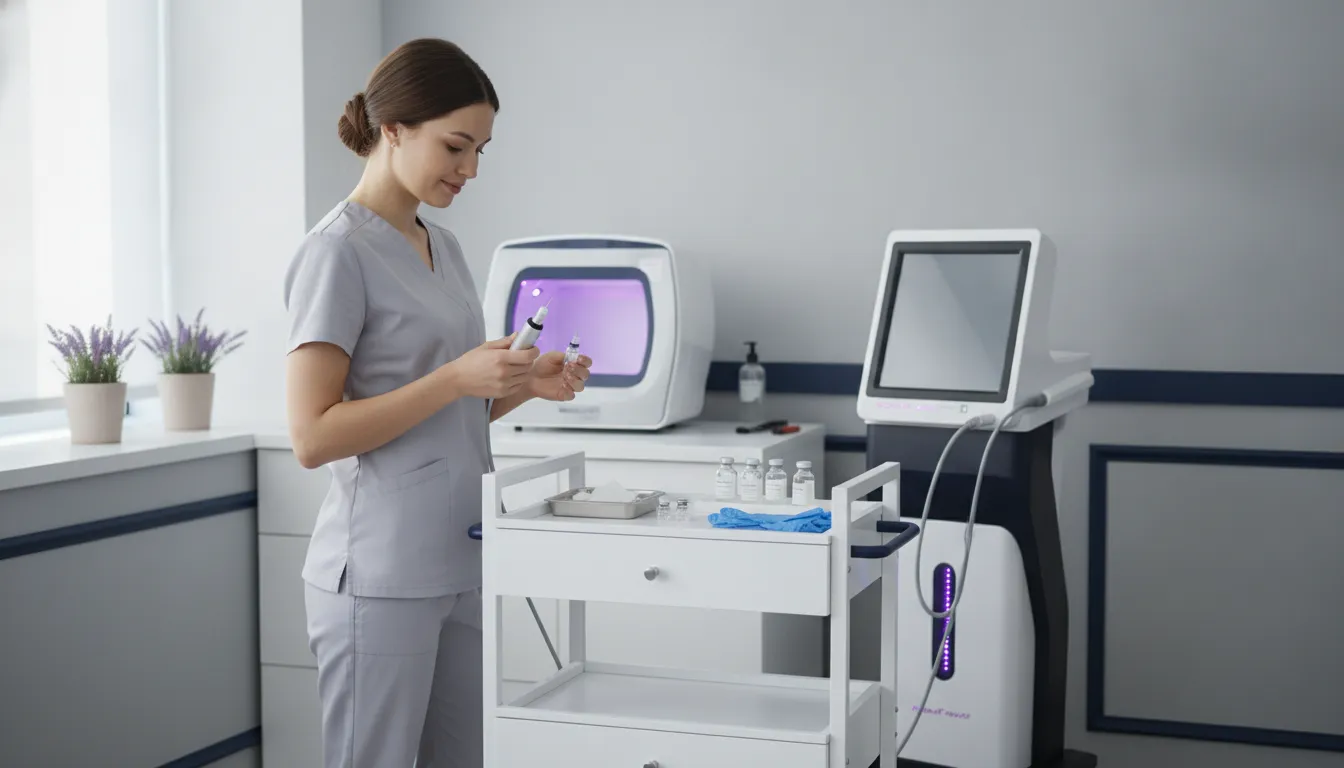
Choosing a first device is less about which platform sounds more advanced and more about the treatments your practice can support consistently. A pen and an RF system both use controlled needle delivery, but they differ in energy. Workflow, training needs, and the patient demand they are best positioned to serve.
The right microneedling pen vs rf microneedling machine decision depends on your starting service menu, licensed clinical oversight, budget, workflow, and growth plan. A professional pen may offer a focused entry point, while RF microneedling can add fractional non-ablative radiofrequency to the treatment platform. FDA clearance describes regulatory status, not a guaranteed patient outcome.
This comparison breaks down what each modality delivers, what it requires from a practice, and how to evaluate ownership beyond the purchase price. Start with the mechanical treatment foundation, then consider whether adding RF addresses a defined clinical and business need. Explore Emage Medical’s professional microneedling devices as you compare your options.
What Does a Microneedling Pen Deliver That an RF Machine Does Not?
A professional microneedling pen delivers a focused mechanical treatment platform without adding radiofrequency energy to the workflow. The device uses rows of fine needles to penetrate the dermis to a controlled depth, creating microscopic punctures that initiate the skin’s healing and remodeling response. That process is associated with collagen and elastin production, although the available literature does not establish strong efficacy evidence for every microneedling indication.
For a practice comparing a microneedling pen vs rf microneedling machine, the most important difference is the modality itself. A pen creates the controlled injury mechanically. An RF microneedling system combines needle delivery with fractional, non-ablative radiofrequency energy. The pen therefore offers a simpler technology stack for practices that want to build a microneedling service around needle depth, cartridge selection, treatment technique, and provider training.
Mechanical delivery can support a broad service menu
Microneedling has been used across several professional applications, including scar treatment, skin rejuvenation, stretch marks, alopecia-related care, drug delivery, and hyperhidrosis. These categories should be understood as clinical use areas described in the literature, not as guarantees for an individual patient. A licensed provider must determine whether a treatment is appropriate, document the indication, and follow applicable state requirements.
The mechanical approach can also fit practices that value a relatively straightforward room setup and repeatable operating workflow. Microneedling is generally described as well tolerated with minimal downtime, but those descriptions do not replace informed consent, infection-control procedures, proper device settings, or patient-specific screening. A pen may be a sensible first platform when the practice’s demand, staffing, and treatment menu center on conventional microneedling rather than energy-based protocols.
What the pen does not add
A standard pen does not deliver the thermal component associated with RF microneedling. That can be an advantage when a practice wants to limit initial technical complexity, but it also means the platform should not be represented as an RF system. Emage’s CytoPen NG is FDA-cleared as a professional microneedling device under K230420, while CytoPen S2 is FDA-cleared as a professional microneedling and microderm device under K241355. FDA clearance describes regulatory status, not a guaranteed clinical outcome.
Review the range of professional microneedling devices alongside your practice’s provider qualifications, patient demand, workflow, training plan, and future expansion goals. The right first platform is the one your team can use compliantly and consistently, with a clear understanding of what it does and what it deliberately leaves out.
What Does RF Microneedling Add Beyond a Standard Pen Treatment?
A standard microneedling pen relies on controlled mechanical penetration. Rows of fine needles enter the dermis to a selected depth, creating small, intentional injuries that activate the skin’s healing and remodeling response. That process can support collagen and elastin production, but the pen itself does not add an energy-based thermal modality. Clinical references describe microneedling’s mechanism and current uses, while also noting that strong efficacy evidence is not established uniformly across the literature.
RF microneedling adds fractional, non-ablative radiofrequency energy to the needle delivery process. In practical terms, the provider is evaluating two coordinated components: mechanical needle placement and the device’s controlled RF delivery. The purpose is not simply to make a pen treatment stronger. It is to give a practice another treatment platform and another way to configure procedures within the provider’s scope, protocols, and patient-selection process. A 2023 review discusses RF microneedling’s mechanism, device features, and uses, but concludes that its role across dermatologic conditions remains an area requiring careful interpretation. Read the RF microneedling review.
What the added energy means for equipment selection
The distinction matters when a practice is deciding whether it needs a mechanical microneedling platform or a broader energy-based system. An RF machine may offer more controls, cartridges, and treatment parameters to evaluate. Those capabilities can be useful for a practice with an established demand for RF microneedling, but they also create a larger training, workflow, maintenance, and compliance conversation. Neither modality should be selected based on a universal promise of superior results.
For example, Emage’s RF microneedling machine, Cyto-RF, is documented as FDA-cleared under K231749 and combines RF microneedling with fractional non-ablative RF in a dual-modality configuration. The product specifications listed in Emage’s knowledge base include a 1 MHz frequency, up to 50 W RF output. 25 Pin, 49 Pin, and 49 RF cartridge options, and adjustable needle depth from 0.25 mm to 3.5 mm. These are Cyto-RF specifications, not universal specifications for every RF microneedling system.
The KB also describes Cyto-RF’s non-insulated needles as delivering RF energy through the full needle length rather than concentrating it only at the tips. That is a design distinction to review with a qualified representative, not an automatic clinical superiority claim. FDA clearance likewise identifies regulatory status for a specific device and indication. It does not guarantee a particular patient’s outcome, and it does not replace licensed medical oversight or applicable state requirements. A practice comparing platforms should therefore assess the device’s documented indications, controls, training, support. And fit with its existing protocols before treating the added energy as a reason to buy.
Investment and ROI: Starting With a Pen vs Committing to a Full RF System
For a practice owner, the first purchase decision is less about choosing the most advanced device and more about matching equipment to the practice’s current service mix. Staffing, patient demand, and growth plan. A professional microneedling pen may offer a focused entry point for practices building a foundational skin-treatment service. A full RF microneedling system may make more sense when the practice is prepared to support a broader technology platform, additional training, and a more deliberate equipment rollout.
Rather than projecting revenue or promising a payback period, evaluate the ownership questions below. The answers should come from your actual appointment patterns, provider availability, clinical oversight model, and plans for expanding the menu. Both purchase and use must remain under appropriate licensed medical supervision and comply with applicable state requirements.
| Planning area | Starting with a professional microneedling pen | Committing to an RF microneedling system |
|---|---|---|
| Upfront planning | Define a focused service menu, room setup, provider availability, consumables, and a realistic launch schedule before adding more equipment. | Plan for the device footprint, treatment workflow, clinical protocols, cartridge or accessory needs, staff readiness, and the broader service strategy. |
| Service menu | Can suit a practice that wants to establish professional microneedling within a focused treatment offering and evaluate demand over time. | Can suit a practice seeking a platform that combines microneedle delivery with fractional, non-ablative radiofrequency energy. Confirm that the intended use aligns with the practice’s clinical model. |
| Workflow | Assess appointment length, room turnover, handpiece handling, infection-control steps, and how the device fits existing provider routines. | Map the complete workflow, including device setup, energy settings, cartridge selection, documentation, patient communication, and post-treatment procedures. |
| Training and support | Prioritize clear onboarding and a support path that helps providers use the platform consistently within their scope of practice. | Ask how training, troubleshooting, protocol education, and ongoing support will work across every provider who may use the system. |
| Compliance | Verify the device’s FDA clearance, intended professional use, supervising provider requirements, and applicable state rules before implementation. | Review the same requirements, then account for the additional documentation and clinical governance needed for an energy-based system. |
| Growth | May provide a measured way to validate demand before expanding the practice’s technology portfolio. | May support a more ambitious expansion plan when the practice has qualified staff, consistent demand, and a defined process for adding the modality. |
Emage Medical supports practices nationwide with shipping and installation, virtual product tours and demonstrations, financing applications, virtual training, and remote support. If the purchase is part of a larger equipment plan, review the available financing options for aesthetic equipment alongside the clinical and operational requirements. The strongest decision is the one the practice can implement responsibly, support consistently, and expand when demand and staffing justify it.
Patient Demographics: Who Benefits Most From Each Modality?
For a practice buyer, “patient fit” should describe the demand your team is prepared to serve, not a promise that one device is right for every patient. The better question is whether your current patient mix, provider expertise, and service model support a standard microneedling platform. An RF microneedling system, or a staged approach that adds capabilities over time.
When a standard microneedling pen may fit the practice
A pen can align with practices whose patients are primarily seeking services built around mechanical microneedling and whose clinicians want a focused, repeatable workflow. The medical literature describes microneedling across several clinical uses, including scars, alopecias, drug delivery, hyperhidrosis. And stretch marks, although the appropriate indication and protocol must be determined by a qualified provider. It is also commonly described as well tolerated with minimal downtime. But that general description does not establish a result for an individual patient or eliminate the need for screening and aftercare planning. Review the clinical overview of microneedling before translating broad evidence into a practice protocol.
This modality may be practical for a dermatology or aesthetic practice building its first device-based service. Adding a complementary procedure to an existing menu, or serving demand that does not yet justify a more complex energy platform. The buying decision should still account for cartridge selection, depth controls, sterilization and infection-control procedures. Staff training, documentation, and the scope of services permitted by the practice’s medical director and state rules.
When RF microneedling demand may justify a broader platform
RF microneedling may fit a practice whose patient demand and clinical capabilities support combining needle delivery with fractional, non-ablative radiofrequency energy. A 2023 review evaluated RF microneedling’s mechanisms, device features, and uses across dermatologic conditions and rejuvenation, but concluded that its role in managing those conditions remains unclear. That evidence limit matters: a practice should evaluate the published literature and device documentation without presenting RF as automatically superior or as a guaranteed outcome. Read the RF microneedling review for the evidence context.
Before choosing a machine, licensed practices should ask: Which patient concerns are already generating qualified demand? Can the medical team select appropriate candidates and manage contraindications? Does the workflow support the device’s controls, consumables, and training requirements? Are the intended indications consistent with the manufacturer’s labeling, FDA clearance, provider scope of practice, and applicable state requirements? FDA clearance identifies regulatory status; it does not guarantee a particular patient result.
Finally, compare the evidence burden with the practice’s communication standards. A 2021 critical review included 42 higher-quality studies, but the number and quality of studies do not remove the need for individualized clinical judgment. The strongest purchase is the one your team can operate compliantly, explain accurately, and support consistently for the patients it is actually equipped to serve.
Is There a Natural Upgrade Path from Microneedling Pen to RF Microneedling?
There can be a practical sequence from a professional microneedling pen to an RF platform, but it should not be treated as a required ladder. Some practices have the demand, staffing, and clinical oversight to begin with RF microneedling. Others may prefer to establish a mechanical microneedling workflow first, then evaluate whether RF adds meaningful value to their service mix. The right order depends on practice readiness, not on the assumption that one device automatically qualifies the practice for the next.
Use the following framework to decide whether expansion makes sense:
- Validate demand before adding a second modality. Review the consultations and treatments your practice already receives, including the questions patients ask, the services providers can confidently support, and the appointment capacity available each month. A pen may be a sensible starting point when the immediate priority is a focused, repeatable microneedling workflow. If demand consistently points toward RF microneedling, evaluate that category directly rather than buying a pen solely as a stepping stone.
- Confirm oversight and compliance requirements. Both categories are professional medical devices. The medical director and licensed providers should confirm scope of practice, supervision, documentation, infection-control procedures, and applicable state requirements before purchase or use. FDA clearance describes a device’s regulatory status; it does not guarantee a particular patient outcome or remove the need for professional judgment.
- Build the workflow and staffing plan. Map consultation, consent, room turnover, cartridge handling, treatment documentation, follow-up, and supply ordering. Then identify who will perform each task and how new providers will be trained. A device that fits the schedule and staff capabilities is more useful than a technically broader platform that the practice cannot consistently operate.
- Evaluate the equipment, not just the modality label. Compare adjustment ranges, cartridge options, treatment controls, ergonomics, service terms, warranty coverage, training, and support. For example, practices reviewing the professional microneedling pen can compare its documented professional indications and workflow against the controls and dual-modality design described for an RF microneedling machine. Specifications should be reviewed against the intended service menu, rather than interpreted as universal clinical superiority.
- Set a review point before committing to expansion. After the initial platform has been integrated, review utilization, staff competency, supply processes, patient demand, and the quality of operational documentation. If those fundamentals are stable and RF remains aligned with the practice plan, request a product demonstration and compare total ownership requirements. If they are not stable, improving the existing workflow may be the better next investment.
Research on RF microneedling includes reviews of device features and clinical uses, while also noting that its role across dermatologic conditions remains unclear. That is another reason to treat an RF purchase as a deliberate equipment decision, not an automatic upgrade. Review the current RF microneedling evidence alongside your practice’s documented needs and professional requirements.
Frequently Asked Questions
Is RF microneedling better than SkinPen?
Not universally. SkinPen is a professional microneedling pen, while RF microneedling adds fractional radiofrequency energy to needle delivery. The better first purchase depends on your patient demand, clinical workflow, provider training, budget, and intended treatment menu. Compare each platform’s clearance, settings, cartridges, support, and ownership requirements rather than assuming one modality is superior.
How much better is RF microneedling than standard microneedling?
There is no single percentage or guaranteed advantage. Standard microneedling creates controlled micropunctures, while RF microneedling combines needle penetration with radiofrequency energy. Research reviews describe potential applications for both, but comparisons with other energy-based devices and the role of RF microneedling across conditions remain unclear. Review the published evidence and assess fit with a licensed medical professional.
Is a microneedling roller a better option than a pen?
For a professional practice, a pen is generally the more relevant comparison because it is designed for controlled, repeatable device-based treatment. A roller may not offer the same depth control, workflow, cartridge, documentation, training, or support model. Confirm that any device fits your practice’s professional-use requirements, applicable state rules, and the indications your licensed providers are prepared to deliver.
Does RF microneedling tighten jowls?
Do not present RF microneedling as a guaranteed tightening treatment. It is used in dermatologic conditions and rejuvenation, and remodeling can be gradual, but outcomes depend on patient selection, treatment parameters, and clinical assessment. A licensed provider should determine whether the modality is appropriate for a specific patient and explain realistic expectations before treatment.
Get Started With the Right First Device
A focused product comparison can help your practice weigh treatment goals, workflow, training, support, and long-term expansion before choosing a platform. To request a comparison or virtual product tour for a professional microneedling pen versus an RF microneedling machine, contact Emage Medical.