

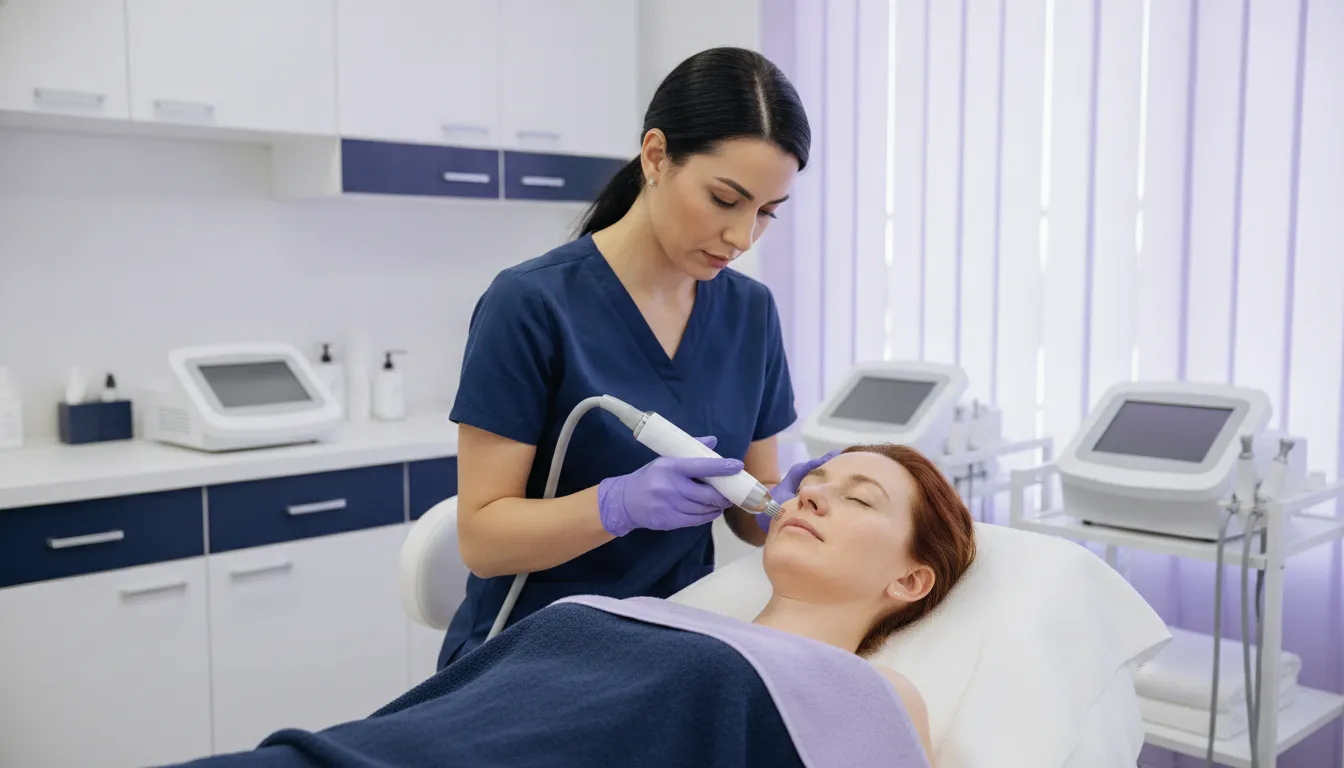
For a practice evaluating energy-based devices, the important question is not only what a treatment is called. But how its mechanism, settings, evidence, and regulatory requirements fit into clinical workflow. RF microneedling pairs controlled needle penetration with radiofrequency energy, creating a modality that differs from standard microneedling in both tissue depth and energy delivery.
In practical terms, what is rf microneedling? It is a minimally invasive skin rejuvenation approach that uses microneedles to deliver RF energy at selected depths. While the practitioner follows device labeling, training requirements, patient-selection protocols, and applicable scope-of-practice rules. A review of 42 higher-quality studies examined applications across several dermatologic concerns, but evidence does not replace individualized clinical judgment (academic review).
Understanding the interaction between needle placement and thermal energy is the foundation for evaluating treatment parameters, cartridge design, and platform capabilities. The clinical-level mechanism comes first.
How Does RF Microneedling Work at the Clinical Level?
RF microneedling combines controlled needle penetration with radiofrequency energy. The handpiece places fine needles into selected tissue depths, then delivers RF heat through or around the needle path. That pairing creates a more parameter-dependent procedure than mechanical microneedling alone: the clinician is managing insertion depth. Energy delivery, pulse or dwell behavior, coverage, and the tissue plane being treated.
Needle penetration establishes the treatment plane
Needle depth determines where the electrode enters the skin and therefore where energy can be delivered. A superficial setting may address the upper portion of the skin, while a deeper setting reaches further into the dermal tissue. The appropriate depth is not a universal number. It depends on the anatomic area, tissue characteristics, treatment objective, device labeling, and the clinician’s assessment of the patient.
This is one reason the phrase what is RF microneedling cannot be answered only by describing the needles. The controlled mechanical entry is one part of the mechanism. RF microneedling is also distinguished from standard microneedling by the way practitioners can select depth and intensity to influence both surface and deeper skin layers. As described in practitioner-facing clinical education from Alastin.
RF heat adds an energy variable
Once the needles are positioned, radiofrequency energy produces controlled thermal exposure in the targeted tissue. The amount and distribution of heat depend on the system’s frequency, output, needle construction, insulation pattern, pulse settings, and contact with the tissue. These variables matter because heat delivery is not interchangeable across platforms. A clinician should evaluate how a device documents its settings and intended use rather than assuming that a power number alone predicts clinical performance.
At a general level, published reviews describe RF microneedling as a modality studied for dermal remodeling and neocollagenesis. Those changes are gradual and may continue progressing for months after treatment, so a treatment plan should distinguish the immediate response from the longer remodeling process. The academic review in PubMed summarizes the evidence base and its limitations across multiple dermatologic applications.
Why platform design and settings matter
Platform design determines how consistently a practitioner can select and reproduce a treatment approach. For example, the Cyto-RF RF microneedling platform is a product-specific system described by Emage Medical as combining RF microneedling with fractional non-ablative RF. Its listed specifications include a 1 MHz frequency, up to 50 W output, non-insulated gold-plated needles. 25 Pin, 49 Pin, and 49 RF cartridge options, and adjustable needle depths from 0.25 mm to 3.5 mm. These are Cyto-RF specifications, not characteristics shared by every RF microneedling device.
Emage Medical also describes the non-insulated Cyto-RF needle design as delivering RF energy through the full needle length rather than concentrating energy only at the tips. That is a device-design distinction, not a guarantee of a particular patient result. In practice, the useful comparison is whether the system’s needle geometry, depth range, energy controls. Cartridge selection, interface, and activation method support the indications and workflow allowed by its labeling.
Every treatment decision still requires professional assessment, appropriate training, adherence to device labeling, and compliance with applicable scope-of-practice and state requirements. Clearance status does not replace clinical judgment or establish a result for every patient.
What Skin Concerns Can RF Microneedling Address?
Published research has evaluated RF microneedling across several dermatologic concerns, but an evidence category is not the same as a universal indication or guaranteed result. A 2021 critical review of 42 higher-quality studies reported applications involving skin rejuvenation, acne scars, acne vulgaris, striae, axillary hyperhidrosis, melasma, rosacea, cellulite, and androgenetic alopecia. The amount and quality of evidence varied substantially by concern, so practitioners should avoid presenting this list as a promise of treatment success. Review the published evidence alongside the device’s labeling and your own clinical protocols.
Common treatment-planning categories
In practice, the most familiar conversations often involve overall skin quality, fine lines and wrinkles, mild laxity, acne-related scarring, and uneven texture. The modality combines controlled needle penetration with radiofrequency energy, which can create a treatment approach that addresses both superficial texture and deeper tissue planes. The review’s findings support repeated use and combination with other modalities in appropriate settings. But combination planning still requires a qualified clinician to consider timing, cumulative tissue response, contraindications, and the labeling for each device.
Other concerns appear in the literature, including striae and axillary hyperhidrosis. Melasma and rosacea require particular care because pigmentary and inflammatory conditions can be complex. And a procedure that is reasonable for one patient may be inappropriate during active disease or with a different treatment history. Cellulite and androgenetic alopecia also appear in the review. Although a reference to a studied application should not be interpreted as proof that every platform, protocol, or patient will have the same response.
Patient selection is part of the indication
Before discussing a concern with a patient, document the diagnosis or clinical presentation, skin condition, prior procedures, medications, healing history, and expectations. A thorough assessment helps distinguish a suitable treatment objective from a condition that needs medical evaluation or another treatment pathway. Skin type and recent sun exposure should be included in the assessment. The Emage Medical knowledge base describes non-ablative RF in the Cyto-RF context as suitable for Fitzpatrick skin types I through VI and usable year-round, including on tanned skin. That product-context statement does not remove the need for patient-specific judgment, conservative settings, and appropriate monitoring.
Practitioners should also confirm that the planned use fits the specific system’s device labeling, training, scope of practice, and state requirements. Cyto-RF is a distinct dual-modality platform that combines RF microneedling with fractional non-ablative RF. So general research on RF microneedling should not be used to infer every Cyto-RF indication or outcome. FDA clearance identifies a regulatory status; it does not guarantee a cosmetic result or replace clinical assessment. Responsible counseling means describing the concern the technology may be used to address, the limits of the evidence, and the possibility that another option may be more appropriate.
How Is RF Microneedling Different from Traditional Microneedling?
Both modalities use controlled needle penetration to create a structured skin-repair response, but RF microneedling adds radiofrequency energy to the treatment plan. That distinction affects how a practitioner evaluates tissue depth, energy delivery, treatment parameters, patient selection, and staff workflow. Neither approach is universally better. The appropriate choice depends on the clinical objective, the device labeling, the operator’s training, and the practice’s treatment model.
| Consideration | Traditional microneedling | RF microneedling |
|---|---|---|
| Primary action | Uses controlled needle penetration to create mechanical micro-injuries and support collagen induction. | Combines controlled needle penetration with radiofrequency energy delivered through or around the needle array. |
| Energy component | Does not add radiofrequency heating. | Adds RF energy, with delivery and tissue effect determined by the system design and selected settings. |
| Parameters | Depth, speed, pass pattern, cartridge, and technique remain central variables. | Requires evaluation of needle depth alongside RF output, pulse or timing controls, cartridge configuration, and treatment area. |
| Workflow | May fit a simpler equipment and setup workflow, depending on the device and practice protocol. | Requires additional attention to energy settings, device controls, treatment documentation, and operator training. |
| Practice decision | Can be appropriate when the treatment objective centers on mechanical needling and the practice’s established protocol. | Can be appropriate when a practice needs a platform that combines needling with RF-based treatment capabilities within its labeling and scope. |
Match the modality to the treatment job
Start with the problem the practice is trying to address, rather than with the most complex device specification. Traditional microneedling may fit a protocol built around mechanical stimulation, controlled depth changes, and a familiar pen-based workflow. RF microneedling may be worth evaluating when the treatment plan calls for needle delivery plus radiofrequency energy and the provider is prepared to manage both variables. Published reviews have evaluated RF microneedling across several dermatologic applications, but evidence for a modality does not replace patient assessment or device-specific labeling. Treatment goals, skin characteristics, contraindications, and expected recovery should guide the plan.
Parameters and training matter
RF microneedling adds another layer of clinical judgment. Needle depth, energy level, pulse settings, cartridge selection, treatment pattern, and tissue area should be selected by a qualified professional using the system’s instructions and applicable state requirements. A device’s ability to reach a certain depth or output does not establish that every setting is appropriate for every patient. Training should cover operation, patient selection, contraindications, endpoint recognition, documentation, and response to adverse events. Practices should also confirm who may perform the procedure under local scope-of-practice rules and medical oversight.
For practices comparing equipment, Emage Medical’s professional microneedling devices provide a useful starting point for reviewing standard and RF-based options. Compare the complete workflow, including cartridges, controls, cleaning, service, training, and documentation, rather than judging a system by needle count or power alone. The strongest choice is the one the team can use consistently, within its training and regulatory framework, for the patient populations it actually serves.
What Results and Recovery Timeline Should Practices Explain?
Practitioners should frame RF microneedling results as a biologic process, not an immediate or uniform endpoint. The treatment creates controlled stimulation in the skin, while the visible changes develop as tissue responds and remodels. A critical review of the literature describes dermal remodeling and neocollagenesis as slow and progressive. With improvement continuing as far as six months after treatment in the reviewed evidence. The review of RF microneedling studies should inform the conversation, but it should not be used to promise the same result or timeline for every patient.
Set expectations around gradual change
Some patients may notice an early change in texture or firmness as short-term swelling settles, but early appearance is not the same as the final treatment response. Collagen-related remodeling takes time. Explain that the evaluation plan should account for the intended concern, treatment parameters, baseline skin characteristics, and the interval needed for the skin to respond. Progress photographs, consistent lighting, and standardized positioning can help a practice assess change more meaningfully than a same-day comparison.
Many treatment plans involve a series of sessions spaced several weeks apart rather than one universal appointment. The appropriate number and spacing depend on the device labeling, the clinical objective, the area being treated, the selected depth and energy, and the patient’s response. A source describing treatment planning notes that optimal outcomes typically require multiple sessions, but that statement is not a rule for every protocol. Practices should follow the applicable labeling, training, and professional judgment rather than presenting a fixed schedule as guaranteed.
Describe recovery without overpromising
Short-term effects commonly reported after RF microneedling include redness, swelling, and mild tenderness in the treated area. One clinical description characterizes these effects as similar to a sunburn and reports that they may last one to two days. Another source describes downtime as usually minimal, ranging from one to three days depending on treatment intensity. These are useful counseling ranges, not universal promises. Patients receiving more intensive treatment, or those with individual sensitivities, may have a different recovery experience.
- Explain the expected appearance and sensation using the device’s instructions and the practice’s approved protocol.
- Tell patients which activities, products, and environmental exposures to avoid during the immediate recovery period.
- Provide clear instructions for contacting the practice if symptoms are unexpected, severe, or worsening.
- Document the settings, treatment area, aftercare guidance, and follow-up plan for continuity.
The most responsible explanation is specific about what is commonly observed while preserving room for individual variation. A patient’s age, skin characteristics, treatment area, selected intensity, prior procedures, adherence to aftercare, and overall health can all affect the experience. Practices should avoid diagnosing through a general education page and should use an in-person assessment to determine whether a particular protocol is appropriate.
Is RF Microneedling FDA-Cleared and What Does That Mean for Your Practice?
FDA clearance is an important device-market distinction, but it is not a promise of a particular patient outcome. In practical terms, clearance indicates that a specific device has met the applicable FDA pathway for marketing for its stated intended use. It does not mean that every RF microneedling system is interchangeable, that every patient is an appropriate candidate, or that treatment results are guaranteed.
For Emage Medical’s Cyto-RF RF microneedling platform, the published regulatory reference is FDA clearance K231749. That statement applies to Cyto-RF and should not be generalized to the entire RF microneedling category. Practices evaluating another device should verify that system’s own clearance documentation, intended use, labeling, and current manufacturer instructions.
Clearance supports a compliant framework, not a clinical guarantee
A cleared device still has to be used within its labeling and under appropriate professional judgment. Regulatory status does not replace patient assessment, contraindication screening, treatment planning, or follow-up. It also does not establish that a particular setting, depth, cartridge, treatment interval, or combination protocol will produce the same result for every patient.
Practices should align marketing language and consultation materials with the device’s cleared indications and instructions for use. Avoid translating clearance into claims such as guaranteed tightening, permanent correction, or suitability for everyone. If a practice discusses applications such as skin tightening, wrinkle reduction, or collagen induction. The clinician should explain that response can vary and that treatment selection depends on the patient’s condition, goals, skin characteristics, and medical history.
Professional oversight and scope of practice still matter
RF microneedling is a professional procedure involving controlled needle penetration and radiofrequency energy. The practice should identify who may perform it, who provides clinical oversight, and what supervision or delegation rules apply. State scope-of-practice requirements vary, so medical directors and practice owners should confirm current rules with the relevant state authority and their compliance counsel. Emage Medical describes eligible users as licensed physicians, NPs and PAs operating within their scope and state regulations, as well as medical spas with licensed supervision.
Training is another part of responsible implementation. Operators should understand the system’s controls, cartridge selection, needle-depth and energy settings, infection-control procedures, contraindications, emergency protocols, and documentation expectations. Training should be specific to the device rather than treated as a substitute for licensure or clinical competency.
Use labeling and informed consent together
Before treatment, informed consent should cover the planned use, expected variability, alternatives, relevant risks, possible temporary reactions, aftercare, and circumstances that warrant follow-up. The record should identify the device and cartridge used, settings, treatment area, skin assessment, operator, supervising clinician where applicable, and patient instructions. This documentation helps the team maintain continuity and evaluate the patient’s response without overstating what clearance means.
For a practice, the best regulatory question is not simply whether RF microneedling is cleared. It is whether the specific system, trained team, written protocols, and oversight structure support use within the device labeling and applicable state requirements.
What Should Practices Evaluate Before Choosing an RF Microneedling System?
Equipment selection should start with the practice’s clinical scope and patient population. A specification sheet is useful, but it does not answer whether the team can implement the system consistently, document its use, and support patients through assessment and follow-up. Use the following sequence to keep the evaluation grounded in clinical and operational fit.
- Confirm intended use and oversight. Review the device’s clearance, indications, instructions for use, training pathway, and state requirements. Identify the licensed professionals responsible for treatment and medical oversight before comparing advanced features.
- Map the treatment parameters. Examine needle depth range, energy output, frequency, pulse or timing controls, needle insulation, cartridge configurations, and treatment-area options. For example, Cyto-RF lists adjustable depths from 0.25 mm to 3.5 mm, but that range describes the device and does not make every setting appropriate for every patient.
- Evaluate workflow controls. Consider how the handpiece is activated, how settings are selected and recorded, whether the interface supports repeatable operation, and what cleaning and infection-control steps the protocol requires. Cyto-RF is described with a foot pedal or handle trigger and a 15-inch LCD touchscreen interface.
- Assess training and documentation. Ask whether education covers operation, patient selection, contraindications, endpoint recognition, aftercare, emergency response, and recordkeeping. A practice should be able to document the cartridge, settings, treatment area, operator, supervising clinician, consent, and follow-up plan.
- Compare support with the real operating model. Review installation, training delivery, technical support, consumables, and escalation paths. Match the system to the providers and patients the practice actually serves, rather than choosing based on a single power or needle-count claim. Emage Medical’s advanced aesthetic technology portfolio provides a starting point for that broader evaluation.
For qualified practices, a product tour can make the comparison more concrete. Ask to see the controls, cartridges, documentation workflow, and training scope, then compare those details with your protocols and applicable requirements.
Frequently Asked Questions
What is the difference between microneedling and RF microneedling?
Traditional microneedling creates controlled micro-injuries with needles. RF microneedling adds radiofrequency energy at selected depths, combining mechanical stimulation with controlled thermal energy. The treatment parameters, needle depth, and energy delivery depend on the specific device and its labeling.
Does microneedling with RF really work?
Published research supports RF microneedling as a clinically studied modality for applications including skin rejuvenation and acne scars. A review of 42 higher-quality studies found that outcomes and treatment planning vary by indication, protocol, patient selection, and device. Practices should communicate potential benefits without guaranteeing a specific result. Review the published evidence.
What are the side effects and recovery time?
Common short-term responses can include redness, swelling, and mild tenderness. One clinical source describes these effects as lasting about one to two days, while other reports note that downtime varies with treatment intensity. Providers should set expectations based on the selected settings, treatment area, patient factors, and aftercare plan. See a clinical recovery description.
Is RF microneedling painful?
Comfort varies with needle depth, energy settings, treatment area, and individual sensitivity. Practices should follow the device instructions for use, use appropriate comfort measures within their training and scope. And explain that sensations and post-treatment tenderness can differ from patient to patient.
Is RF microneedling safe for every patient?
No modality is appropriate for every patient. Screening, contraindication review, device labeling, training, informed consent, and state scope-of-practice requirements should guide treatment decisions. FDA clearance applies to a specific device and intended use, not to every patient or a guaranteed cosmetic outcome. Qualified professionals should make the final clinical determination.
Get started with a Cyto-RF product tour
Choosing an RF microneedling system involves more than comparing energy delivery. A closer look at the platform, cartridges, workflow, training, and labeling can help your practice evaluate whether it fits your clinical and operational needs. To learn more about the Cyto-RF system and discuss the next step, request a product tour with Emage Medical.