

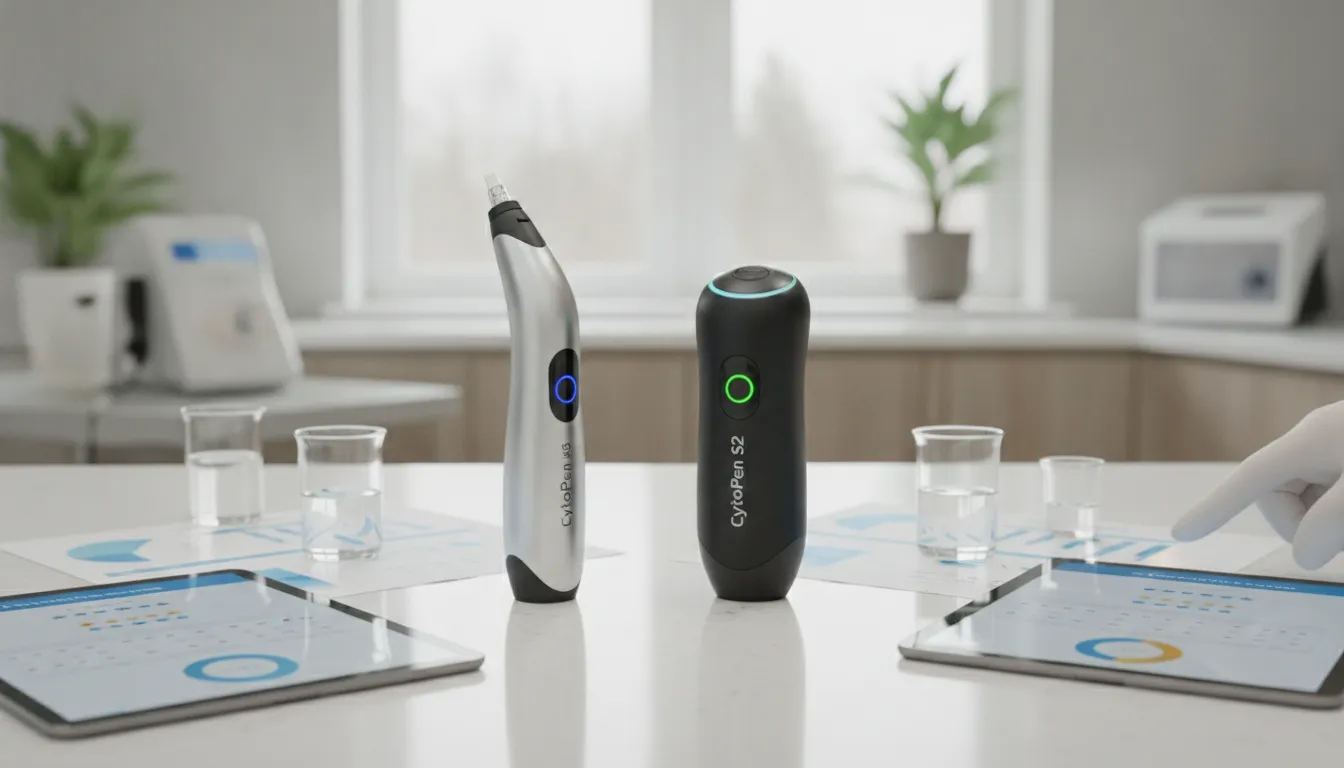
Online reviews often focus on a device’s headline specifications. For an aesthetic practice, the details behind those specifications matter more. Can your staff change cartridges quickly? Does the handpiece feel balanced during a full appointment? Will cordless treatment help your room setup? Are replacement tips easy to order, and what support is available after installation? These are the questions cytopen microneedling pen reviews should answer. In this comparison, we look at the CytoPen NG and CytoPen S2 through a practical clinical and business lens. You will learn how to compare their features, costs, training resources, ownership needs, and fit for your treatment menu.
Key Takeaways
- Match the device to your practice: Choose the CytoPen NG for essential microneedling needs and a lower starting cost, or consider the S2 if cordless treatment and multiple tip options fit your daily services.
- Assess total ownership costs: Budget for cartridges, staff time, training, financing, maintenance, marketing, and other recurring expenses before estimating profitability.
- Evaluate the complete support package: Request a demonstration, verify FDA documentation and local requirements, and confirm training, warranty coverage, technical assistance, cartridge availability, and replacement procedures.
What Should CytoPen Microneedling Pen Reviews Cover?
A useful CytoPen microneedling pen review should do more than repeat a device’s maximum needle depth. Aesthetic practices need practical information about how a pen fits into treatment protocols, how quickly staff can prepare it, and whether its features support consistent care across different clients and treatment areas.
Reviews should compare the CytoPen NG and CytoPen S2 while covering FDA clearance, cartridge design, controls, ergonomics, sanitation, training, and ongoing support. A busy medical spa may value cordless treatment and interchangeable tips, while a smaller practice may prefer a simpler corded workflow and lower initial cost. The right choice depends on your menu, team, space, and treatment volume.
Reviews should also separate documented specifications from personal opinions. Words such as “comfortable,” “quiet,” and “easy to use” can mean different things to different providers. Look for details about the reviewer’s experience, treatment volume, protocols, and client population. That context makes it easier to decide whether the feedback applies to your practice.
Compare Emage Medical’s CytoPen NG and S2
Emage Medical offers two professional microneedling devices, the CytoPen NG and CytoPen S2. Both are designed for clinical use and presented as FDA-cleared options for practices that want to add or expand microneedling services. Review the complete CytoPen microneedling lineup before comparing individual models.
The devices differ in ways that can affect daily workflows. The NG focuses on adjustable speed, a 16-needle cartridge, and corded operation. The S2 adds corded and cordless use, dual-battery operation, a greater maximum depth, and multiple tip options. A strong review should explain how those differences affect setup, handling, treatment flexibility, and room turnover. Neither model is automatically the best fit for every practice.
Review FDA Clearance, Intended Use, and Provider Responsibilities
FDA clearance should be one of the first areas a professional device review covers. Emage Medical identifies the CytoPen NG and S2 with clearance numbers K230420 and K241355. Providers can review the CytoPen product information and confirm that the device’s cleared indications match the services they plan to offer.
Clearance does not replace clinical judgment or practice requirements. Each provider remains responsible for following applicable state rules, facility policies, infection-control procedures, insurance requirements, and manufacturer instructions. Reviews should also address informed consent, client screening, treatment documentation, staff training, and aftercare guidance. FDA clearance supports a device’s regulatory status, but it does not guarantee a specific result for every client.
Examine CytoPen NG’s Seven Speeds, 16-Needle Cartridges, and 2.3 mm Depth
The CytoPen NG features a 16-needle cartridge, seven adjustable speed settings, and needle depths of up to 2.3 millimeters. These specifications give providers options for adjusting the treatment approach based on the area, skin characteristics, protocol, and professional judgment. A review should explain how easily staff can make those adjustments during an appointment.
It should also assess how the handpiece performs across facial contours and whether the controls are easy to reach while wearing gloves. Cord placement, setup time, cartridge changes, and cleaning procedures can affect the pace of a busy schedule. Maximum depth should be presented as one available setting, not as a recommended approach for every client. Providers should follow training, device instructions, and established clinical protocols when selecting settings.
Examine CytoPen S2’s Cordless, Dual-Battery Design and 2.5 mm Depth
The CytoPen S2 supports corded and cordless operation, with a maximum treatment depth of 2.5 millimeters. Its dual-battery design may help practices move between treatment rooms or continue working while one battery charges. For providers who perform several appointments in different rooms, removing a power cord from the treatment area may also simplify positioning.
A useful review should assess how the cordless setup performs during a full treatment day. Consider battery life, charging time, battery replacement, handpiece balance, and comfort during longer appointments. The additional depth also deserves attention, but it should not be treated as a universal advantage. Treatment depth should reflect the area, client assessment, protocol, and provider training. Reviews should explain when the added flexibility is useful rather than assuming every practice needs it.
Compare S2’s 12-Pin, 36-Pin, and Nano Microdermabrasion Tips
The S2 includes interchangeable 12-pin and 36-pin cartridges, plus a nano-tip option for product infusion. This range may help a practice tailor services to different treatment areas and goals. Still, a review should connect each tip to a real workflow instead of listing the options without context.
Reviewers can compare how the cartridges handle areas with different contours, how quickly they can be changed, and how staff learn to use them consistently. The nano tip also deserves a closer look, including the practice’s approved product, sanitation, storage, and documentation procedures. Cartridge availability and replacement pricing matter, too. Versatility is useful only when the team can access the necessary components and use each option confidently within its training and protocols.
Review Adjustable Controls, No-Leak Cartridges, and Quick Changes
Both CytoPen models feature adjustable controls and self-contained cartridges designed to prevent leaks. The cartridges are also described as easy to replace, with a click-in design intended to simplify preparation between clients. These details may support a more orderly workflow, particularly when a practice performs multiple treatments in one day.
A practical review should test the cartridge system with gloved hands and assess whether staff can confirm a secure connection quickly. It should also cover cleanup, disposal, packaging, storage, and the possibility of interruptions during treatment. No-leak construction may reduce mess, but it does not eliminate the need for proper infection-control procedures. Practices should follow the manufacturer’s instructions and their own policies for handling, cleaning, and disposing of treatment components.
Assess Smart Algorithms, Self-Sanitizing Features, and Included Components
Emage Medical promotes smart algorithms, self-sanitizing equipment, and electronically aligned before-and-after photos as part of the CytoPen system. Reviews should explain what each feature does, how staff access it, and whether it changes daily operations. Technology terms alone do not demonstrate better clinical results, so reviewers should avoid presenting them as guarantees.
It is also helpful to document everything included with each device. Check the handpiece, power components, batteries, charging equipment, cartridge types, storage case, and instructional materials. If a feature requires a separate accessory, software process, or additional purchase, note that clearly. A complete review should also consider whether the included materials help staff begin safely and confidently. Practices can then estimate their actual setup needs before making a purchase.
Look Beyond Maximum Depth When Evaluating Treatment Quality
Maximum depth is easy to compare, but it tells only part of the story. Treatment quality also depends on needle consistency, speed control, handpiece balance, cartridge performance, provider technique, skin assessment, and aftercare instructions. A deeper setting does not automatically mean a better treatment or stronger result.
When reading reviews, look for evidence of repeatable workflows. Does the provider describe consistent passes, predictable handling, and clear documentation? Are client comfort and recovery discussed alongside treatment goals? Reviews should distinguish personal experience from measured outcomes. Emage Medical describes its microneedling technologies as professional solutions, but providers should evaluate product claims alongside training, device documentation, clinical judgment, and their own practice standards.
How Do CytoPen NG and S2 Compare in Professional Use?
Choosing between the CytoPen® NG and CytoPen® S2 involves more than comparing the purchase price. Both devices are designed for professional microneedling, but each one supports a different treatment workflow. The NG focuses on core microneedling functions and a lower initial investment. The S2 adds cordless flexibility, expanded cartridge options, and a slightly deeper maximum treatment depth.
Start by considering how each device fits your treatment menu, room layout, provider preferences, and appointment volume. A device that looks impressive on paper may not be the best choice if its controls, cartridges, or power requirements do not suit your team. Emage Medical’s microneedling technology lineup provides current product information, while a demonstration can help providers compare the handpieces in a realistic setting.
Your purchasing review should also include training, warranty coverage, replacement parts, cartridge availability, financing, and technical support. These details affect the experience long after installation. Confirm that your planned protocols align with provider training, state requirements, infection-control procedures, and professional liability coverage. The right device is the one your team can use consistently, safely, and efficiently.
Compare Specifications and Upfront Costs
The CytoPen NG and CytoPen S2 are both FDA-cleared microneedling devices intended for professional use. Their listed prices differ, however. The NG is priced at $2,490, while the S2 is priced at $3,290. That $800 difference makes the NG a more accessible option for practices with a limited equipment budget or those adding microneedling for the first time.
The S2’s higher price may make sense for a practice that expects to use its cordless operation and expanded cartridge selection regularly. Before choosing, compare the device price with cartridge expenses, financing terms, training, expected treatment volume, and planned service pricing. A lower initial cost does not always result in a lower total cost over time.
Review the specifications alongside your practice policies. Ask which components are included, how cartridges are ordered, and what support is available after purchase. You should also confirm that the device and planned protocols fit the scope of practice for each provider who will use it. Emage Medical’s microneedling product information is a useful starting point for this comparison.
Compare the NG’s Corded and S2’s Cordless Workflows
The CytoPen NG is designed for battery-powered use, while the CytoPen S2 supports both cordless and corded operation. This distinction can affect how easily providers move around the treatment bed, reposition the handpiece, and transition between the face, neck, and other treatment areas.
Cordless operation may suit rooms where cables create clutter or limit movement. The S2’s corded option gives providers another choice when they prefer continuous power during a busy treatment block. Before purchasing, ask about battery life under typical use, charging time, battery replacement, and how the device performs while connected to power.
The NG’s simpler power setup may appeal to providers who prefer a consistent routine with fewer decisions during treatment. The S2 may be a better fit for teams that value mobility and want the option to switch between power modes. Consider your room layout, appointment length, and daily treatment volume rather than choosing based on cordless operation alone.
Assess Speed, Depth, and Treatment Customization
The CytoPen NG offers up to seven adjustable speeds and a maximum needle depth of 2.3 millimeters. The CytoPen S2 operates within a speed range of 7,000 to 10,000 RPM and reaches a maximum depth of 2.5 millimeters. The S2 therefore provides a slightly broader range for practices that want additional control over treatment settings.
Maximum depth does not determine treatment quality by itself. Providers should select settings according to the treatment area, skin characteristics, client history, treatment goals, and professional training. A deeper setting is not automatically more effective, and every protocol should follow the manufacturer’s instructions and applicable clinical standards.
During a demonstration, ask providers to adjust speed and depth as they would during a real appointment. Controls should be easy to locate and change without interrupting client communication or treatment flow. You can review Emage Medical’s CytoPen specifications when comparing the listed speed and depth ranges.
Match Cartridge Options to Treatment Areas
The CytoPen NG uses a 16-needle cartridge. The CytoPen S2 is compatible with interchangeable 12-pin and 36-pin cartridges, along with a nano microdermabrasion tip. This gives the S2 more configuration choices for practices that want to tailor treatments to different areas or service protocols.
More options are useful only when they support services your practice actually plans to offer. A clinic focused on facial microneedling may find that the NG provides the necessary setup without adding extra inventory. A practice with a broader treatment menu may prefer the S2’s interchangeable options.
Review how cartridges are packaged, stored, opened, disposed of, and reordered. Single-use components affect appointment preparation and ongoing supply costs. Ask which products and serums are compatible with each cartridge and protocol, and document the information in your standard operating procedures. Clear handling processes help every provider deliver the same experience.
Compare Handling, Vibration, Noise, Setup, and Battery Use
A device can have strong specifications and still feel uncomfortable during a full appointment. During a demonstration, evaluate the handpiece weight, grip, vibration, button placement, and balance. Providers should be able to maintain consistent contact with the skin without unnecessary hand or wrist strain.
The NG is described as lightweight and designed for efficient use. The S2 features a quiet German motor, which may create a more comfortable environment for clients and providers. Noise matters when providers are explaining the procedure, answering questions, or discussing aftercare during treatment.
Both devices are designed for straightforward setup, but the S2’s two operating modes add battery-management tasks. Establish a charging routine, keep track of ready-to-use batteries, and assign responsibility for storage and cleaning. Ask how long setup takes from opening the device to beginning treatment. These small details matter when several appointments are scheduled in one day.
Consider the S2’s Mobility, Versatility, and Aluminum Build
The CytoPen S2 has an aluminum shell and supports both corded and cordless operation. Its construction may appeal to practices looking for a durable handpiece with greater freedom of movement during treatment. A professional appearance can also contribute to how clients perceive the treatment environment, although usability should remain the priority.
Cordless operation can make it easier to work around the face and neck without moving a power supply or managing a cable. It may also suit practices with multiple treatment rooms or providers who reposition equipment throughout an appointment. The S2’s cartridge options add flexibility for teams with several treatment protocols.
That flexibility has the greatest value when providers will use it regularly. If your menu centers on one microneedling service, compare the S2’s additional features with projected utilization. A hands-on review can help your team decide whether the aluminum build, cordless design, and cartridge selection justify the higher purchase price.
Consider the NG’s Lower Cost and Simple Controls
The CytoPen NG may suit practices that want to add professional microneedling without making a larger equipment investment. Its listed price is $2,490, and its controls focus on the core adjustments providers need during treatment.
A simpler device may make onboarding easier for a small team or a practice with limited microneedling experience. Fewer configuration choices can also help providers follow a consistent protocol while they build familiarity with the handpiece. This does not replace formal training, but it may reduce unnecessary complexity in daily use.
The NG can be a practical option for a focused treatment menu, limited room space, or a clear preference for essential features. Review the NG’s current details and ask about included components, replacement cartridges, training, and warranty coverage before ordering. The lower price should be evaluated alongside long-term supply and support needs.
Compare Workflow Instead of Marketing Claims
Product descriptions can help create a shortlist, but your final decision should reflect how each device works in your practice. Ask providers to handle both models, test the controls, and describe which handpiece feels easier to use during a complete treatment sequence.
Compare setup time, cartridge changes, cleaning procedures, charging requirements, treatment documentation, and storage. Consider how quickly a new team member could learn the device and how easily staff can get answers when questions arise. If possible, include more than one provider in the demonstration so the decision reflects different hand sizes, techniques, and treatment schedules.
Claims about affordability, speed, or versatility should be reviewed alongside written specifications and service terms. Request user instructions, training details, warranty information, and replacement policies. Emage Medical also offers marketing support for practices, which may be relevant when comparing the total value of each device rather than the handpiece alone.
Track Performance After Adding a Device
Once you select a device, track its performance instead of relying on first impressions. Record consultations, completed treatments, rebooking rates, cartridge usage, cancellations, staff training time, and client feedback. These metrics can show whether microneedling is becoming a sustainable part of your service menu.
You can also calculate revenue based on treatment volume. Emage Medical’s materials use an example of one client per day, five days per week, producing approximately $78,000 in annual treatment revenue. This is a projection, not a guarantee. Actual results depend on pricing, demand, provider availability, consumable costs, marketing, and operating expenses.
Review the service after the first 30, 60, and 90 days. If appointments are slower than expected, examine consultation messaging, follow-up, scheduling, and staff confidence before assuming the device is the problem. Practices can also review Emage Medical’s financing programs and support options when planning the investment.
What Do CytoPen Reviews Reveal About Results and Support?
CytoPen reviews highlight two factors that matter to aesthetic practices: treatment performance and the support available after purchase. First-party testimonials describe improvements in skin texture and positive treatment outcomes, while Emage Medical’s product information focuses on adjustable settings, cartridge design, and provider education.
That feedback can help you build an initial picture of the device, but reviews should not be the only basis for a purchasing decision. A useful evaluation separates customer experiences from manufacturer claims and considers how treatment protocols, provider training, client selection, and aftercare may affect results.
Support also deserves close attention. A microneedling device becomes part of your daily workflow, staff training process, client consultations, and service menu. The right support can make it easier to introduce a new treatment responsibly and maintain consistent standards as your team grows.
Review Reported Texture Improvements and Treatment Outcomes
Testimonials on the CytoPen NG product page mention improved skin texture and positive treatment results. For a medspa, dermatology clinic, or plastic surgery practice, this feedback may help show how professional microneedling could fit into an existing service menu.
Reported outcomes are not guarantees, however. Client response may vary according to skin concerns, treatment settings, appointment frequency, product use, healing, and adherence to aftercare instructions. Before making claims in consultations or marketing, review the device’s intended use and your professional obligations.
When assessing results, look for specific details. Does the review describe the treatment area, the number of sessions, the client concern, or the follow-up period? Specific context makes feedback more useful than a general statement that a treatment worked well.
Assess Client Comfort, Ease of Use, and Treatment Control
Client comfort is difficult to judge from brief online reviews. A more useful evaluation considers whether providers can control speed and depth, maintain a consistent technique, and adjust treatment for different areas of the face and body. Staff should also understand how treatment settings relate to the practice’s protocols and scope of service.
Ease of use matters just as much. CytoPen devices are marketed for medspas, day spas, plastic surgery clinics, dermatology clinics, and other aesthetic practices. A live demonstration can help your team assess handling, vibration, sound, setup, and cartridge changes between clients.
Ask providers to demonstrate a complete workflow, from preparing the device to documenting the treatment and disposing of used components. This gives you a clearer sense of how the pen may fit into appointment times, room turnover, and staff responsibilities.
Understand What CytoPen Reviews Can and Cannot Prove
CytoPen reviews can describe a provider’s or customer’s experience, but they cannot independently confirm every performance, safety, or financial claim. For example, the NG product page describes the device as the “most affordable FDA-cleared microneedling device.” That is a marketing statement, and the page does not independently substantiate the comparison.
Reviews also cannot replace your practice’s own compliance review. Confirm the device’s intended use and clearance information through the manufacturer and the FDA’s medical device resources. Your team should also follow applicable state requirements, infection-control procedures, insurance conditions, and professional standards.
Be especially careful with reviews that make clinical or revenue promises without explaining how the claim was measured. A review can support a question for the manufacturer, but it should not take the place of product documentation, training, or professional judgment.
Compare First-Party Testimonials With Independent Feedback
First-party testimonials can provide useful details about perceived skin texture changes, treatment outcomes, and the experience of working with Emage Medical. They may also show which types of practices use CytoPen and how providers position microneedling within their service offerings.
Independent feedback can provide another perspective, particularly when it discusses setup, maintenance, cartridge changes, and day-to-day handling. When comparing sources, look for specific observations rather than broad praise. Ask who used the device, how frequently they used it, which protocols they followed, and whether the feedback relates to treatment performance or business results.
It also helps to separate the reviewer’s role from the client’s experience. A provider may comment on control and workflow, while a client may comment on comfort and visible changes. Both perspectives can be helpful, but they answer different questions.
Consider Limited Independent Reviews and Open Performance Questions
Available CytoPen materials include promotional claims about savings and return on investment, but they do not provide specific prices, savings amounts, ROI figures, clinical results, or comparisons with named competing devices in every source. That leaves important questions for a practice to answer before making a purchase.
Request a demonstration, sample protocol, and complete ownership details from Emage Medical. Ask how the device performs during a typical treatment day, how often cartridges are replaced, what technical support includes, and whether the company can connect you with practices willing to discuss their experience.
You can also create a short evaluation period for your team. Have providers record setup time, treatment duration, cartridge changes, cleaning steps, client feedback, and follow-up questions. Those notes will give you more relevant information than generic online ratings.
Evaluate Cartridge Reliability, Serum Compatibility, and Aftercare
Emage Medical describes CytoPen cartridges as self-contained and designed to prevent leaks. Its professional-use materials also state that cartridges are easy to replace and click into place. If accurate in daily use, these features may simplify setup and support a consistent workflow.
Your practice should still confirm which cartridges are compatible with each model and what products may be used during treatment. Ask about approved serums, storage, disposal, cleaning, and post-treatment instructions. Do not assume that every serum or topical product is appropriate for use with a microneedling device.
Clear aftercare guidance helps staff set expectations and gives clients practical steps for protecting treated skin during healing. Include instructions in writing, explain when clients should contact the practice, and make sure all providers deliver the same information.
Set Realistic Healing Expectations, Protocols, and Results
Microneedling results develop over time, and clients may experience temporary redness, sensitivity, or other expected responses after treatment. Providers should explain the anticipated healing process during consultation and provide written aftercare based on device instructions, professional training, and applicable clinical requirements.
Avoid promising a specific result or timeline. Instead, create protocols that account for treatment area, client history, skin condition, settings, and follow-up care. Your consultation process should identify clients who may need additional evaluation or referral before treatment.
Consistent photography and progress reviews can help providers assess changes more accurately. Use the same lighting, camera position, and timing whenever possible. If a client reports an unexpected reaction, staff should follow the practice’s escalation and referral procedures rather than offering an improvised solution.
Use Free, Unlimited One-on-One Warranty-Period Training
Emage Medical states that it offers unlimited, free one-on-one training during the warranty period. This may be helpful for practices onboarding new team members or refining their treatment workflow after purchasing a device.
Before signing an agreement, ask how training is delivered, who provides it, and whether sessions cover device operation, cartridge changes, treatment planning, and client communication. Confirm whether training is remote, in person, or available through both formats.
It is also worth asking how long new staff can access training and whether sessions can be scheduled for different experience levels. Keep a record of completed training, protocol materials, and staff questions. That documentation can support consistency when several providers use the same device.
Access Treatment Guidance, Consultations, Troubleshooting, and Education
Emage Medical states that its training includes treatment guidance, consultations, and sales support. These resources may help a practice move from equipment delivery to a usable service offering, particularly when providers have different levels of experience.
Ask whether the support team can assist with common troubleshooting questions, protocol development, treatment consultations, and staff education. A clear contact process matters when a device issue occurs during a busy schedule. You should know who to contact, how quickly the team typically responds, and which concerns require technical service instead of treatment guidance.
Request support details in writing before purchasing. Clarify whether consultations are included, whether there are limits on support, and whether educational materials can be shared with newly hired staff. Strong communication can reduce avoidable delays and help your team use the device more consistently.
Review Warranty Coverage, Replacements, Delivery, and Technical Support
Each CytoPen includes a two-year warranty, according to Emage Medical’s professional-use materials. That coverage is an important part of the purchase decision, but the headline term does not explain every condition or exclusion.
Request the full warranty language and confirm what happens if a device needs repair or replacement. Ask who pays for shipping, how long service typically takes, whether loaner equipment is available, and how replacement cartridges are ordered.
Also clarify delivery timing, inspection requirements, and the process for reporting damage or defects when the device arrives. If a device becomes unavailable, ask how the company supports appointments already on your calendar. Understanding the service process in advance helps your practice plan for interruptions and communicate clearly with clients.
Use Marketing Assistance and Sales Resources to Grow Your Practice
Support may extend beyond treatment training. Emage Medical promotes marketing assistance and sales resources, along with tools such as smart algorithms, self-sanitizing equipment, and electronically aligned before-and-after photos. These features may help practices organize consultations and treatment documentation.
The company also states that its devices can help practices attract people who might otherwise use at-home solutions and introduce them to professional services. Treat that possibility as a business hypothesis, not a guaranteed source of new or repeat clients. Your results will depend on pricing, positioning, staff confidence, client demand, and follow-up.
Ask what marketing materials are included, whether staff receive sales training, and how campaigns can be adapted to your practice’s audience and services. You should also confirm which claims and images may be used in advertising, then review all materials for accuracy and compliance before publishing them.
How Much Do CytoPen NG and S2 Cost?
The CytoPen NG and CytoPen S2 have different price points, but the purchase price is only one part of your practice’s investment. To compare the two models fairly, account for cartridges, financing, staff training, treatment time, maintenance, and the number of appointments you expect to perform each month.
Emage Medical lists prices for both devices, but costs, promotions, and included accessories can change. Before ordering, confirm the current price, warranty coverage, shipping charges, starter supplies, and training terms with a representative. The CytoPen NG and S2 product information can help you prepare a list of questions for that conversation.
Your practice should also consider how the device fits into its current service menu. A lower purchase price may appeal to a practice adding microneedling for the first time, while a higher-priced device may make sense if its workflow and treatment options support more appointments. Look at expected utilization, not just the number on the quote.
Create a simple budget before making a decision. List one-time expenses separately from recurring costs, then estimate how many treatments you need to cover the investment. This gives you a clearer picture of affordability and helps you compare the NG and S2 based on your actual business needs.
Review the NG’s Listed Price of $2,490
The CytoPen NG has a listed price of $2,490, making it the lower-cost option compared with the S2. For practices adding professional microneedling to an established menu, the NG may provide a more accessible entry point while limiting the upfront equipment expense.
Do not evaluate the listed price in isolation. Ask what the purchase includes, such as the handpiece, power supply, cartridges, training, warranty coverage, and shipping. If any of these items are purchased separately, they should be included in your initial budget.
The NG may be a practical choice for a practice with a focused microneedling menu and predictable treatment needs. It may also suit providers who prefer a straightforward setup rather than paying for features they may not use regularly.
Before placing an order, confirm the current price and package contents through the official CytoPen product page. Request a written quote so you can compare the NG with the S2 and account for all upfront charges accurately.
Review the S2’s Listed Price of $3,290
The CytoPen S2 has a listed price of $3,290, which is $800 more than the NG. The higher cost is associated with features such as cordless operation, a dual-battery design, and a wider selection of treatment tips.
That difference may be worthwhile for providers who move between treatment rooms, want fewer cables around the client, or plan to offer several microneedling approaches. A cordless workflow can also make setup and repositioning more convenient during appointments.
However, additional features only create value when they support your daily operations. Review your treatment menu, room layout, appointment volume, and provider preferences before paying more for expanded flexibility. If most treatments use the same settings and cartridge type, the NG may meet your needs at a lower cost.
Ask Emage Medical for a current S2 quote and a complete list of included components. You can also review the S2’s microneedling features when comparing its design with the NG.
Estimate Cartridge Costs of About $27.90 to $32.90
Cartridges create a recurring cost, so include them in your financial planning from the beginning. Listed CytoPen cartridge prices range from about $27.90 for 12-needle tips to $32.90 for 36-needle tips. The appropriate option may depend on the treatment area, client goals, provider preference, and protocol.
To estimate monthly cartridge expenses, multiply the price of one cartridge by your expected treatment volume. For example, 20 treatments using a $27.90 cartridge would cost approximately $558 in cartridges for that month. Your actual expense may be higher if an appointment requires more than one cartridge or uses multiple tip types.
Confirm whether cartridges are intended for single use, how they should be stored, and how they should be discarded. Also ask about ordering quantities, shipping fees, availability, and any differences between cartridge options.
Use the CytoPen cartridge information as a starting point, then confirm current pricing before finalizing your treatment margins. Small differences in consumable costs can affect profitability when appointment volume increases.
Confirm Financing Terms and Eligibility From $74 per Month
Financing can spread the equipment cost across monthly payments instead of requiring the full amount at purchase. Emage Medical promotes financing options starting at $74 per month, but your actual payment will depend on the purchase amount, repayment term, approval, and applicable fees or interest.
Treat the advertised monthly payment as an example, not a guaranteed offer for every practice. Ask about eligibility, credit requirements, down payment expectations, payment frequency, total repayment amount, and early-payment terms. Find out whether cartridges, accessories, shipping, or training can be included in the financed amount.
Your monthly payment should fit comfortably within your expected contribution from microneedling appointments. To estimate that contribution, subtract cartridge costs, provider compensation, payment processing, room use, and other appointment expenses from the treatment price.
Review Emage Medical’s financing programs before requesting a quote. A representative can explain the current terms and help you understand the total cost rather than focusing only on the monthly payment.
Check Current Discounts, Promotions, Bundles, and Offers
Promotions may change your total purchase cost, so ask about current offers before accepting a quote. Depending on the terms, savings may apply to the device, cartridges, accessories, shipping, training, or a package that includes another aesthetic technology.
A bundle can make sense when you already plan to add related services. It is not automatically the best option, though. Compare the bundled price with the cost of purchasing only the equipment your practice needs. Unused technology still represents an expense, even when the package appears discounted.
Request promotional details in writing. Confirm the offer’s eligibility requirements, expiration date, included items, return policy, and warranty coverage. Ask whether discounted cartridges have the same ordering and replacement terms as standard supplies.
Review Emage Medical’s aesthetic technology portfolio if you are planning a broader service expansion. This can help you compare potential bundles against your actual treatment menu rather than choosing equipment based only on the size of the discount.
Calculate Total Ownership Costs, Including Cartridges, Maintenance, Training, and Staff Time
The device price does not represent the full cost of ownership. Your estimate should include cartridges, shipping, cleaning supplies, payment processing, staff training, appointment time, room use, marketing, maintenance, and possible replacement expenses.
Training can reduce the time staff need to become comfortable with the device. Emage Medical states that it provides free, unlimited one-on-one product training during the warranty period. Confirm what those sessions include, how they are scheduled, and whether they cover device operation, cartridge selection, treatment protocols, troubleshooting, and client education.
Staff time also affects your margins. Include consultation time, treatment time, room turnover, documentation, and follow-up communication when estimating the labor cost of each appointment. A treatment that appears profitable at first may produce a smaller contribution after these expenses are included.
Create two budgets: one for startup costs and another for monthly operating costs. You may also review Emage Medical’s marketing support services if you plan to promote microneedling or introduce a new treatment package.
Plan Break-Even Based on Treatment Volume and Pricing
Break-even planning estimates how many appointments you need to cover the equipment investment. Start with your treatment price, then subtract variable expenses such as the cartridge, consumables, provider compensation, payment processing, and appointment-related supplies. The remaining amount contributes toward the device and other fixed costs.
For example, a $300 treatment does not contribute the full $300 toward equipment recovery. If the cartridge costs $27.90, subtract that amount first. Then account for labor and other expenses. Divide the device price by the estimated contribution from each appointment to create a basic payback estimate.
Apply the same calculation to the S2. Its additional $800 cost may be reasonable if cordless use and expanded treatment options help you schedule more appointments or offer higher-value services. If your volume is uncertain, calculate separate low-demand, expected-demand, and high-demand scenarios.
Review the estimate after launch using real appointment data. Track bookings, cancellations, cartridge use, treatment prices, and labor costs. This will show whether your original assumptions reflect how the device performs in your practice.
Treat Revenue and ROI Projections as Estimates, Not Guarantees
Revenue examples can support planning, but they should never be treated as promises. Emage Medical describes a scenario in which one client per day, five days per week, could generate approximately $78,000 per year, based on an example treatment price of $300. Actual results depend on demand, location, pricing, provider availability, cancellations, and repeat bookings.
Build your own projection using realistic assumptions. Estimate how many appointments you can perform each week, how quickly your schedule may fill, and how many clients may return for additional treatments. Include no-shows, introductory discounts, complimentary consultations, seasonal demand, and time spent on follow-up care.
Separate gross revenue from net contribution. Gross revenue is the amount collected from clients. Net contribution accounts for cartridges, labor, payment fees, supplies, marketing, and other operating costs. This figure provides a more useful basis for payback planning.
Update your projection as real data becomes available. If your practice performs fewer treatments than expected, revise the timeline. If demand is stronger or operating costs are lower, update the estimate accordingly. A practical model keeps your purchase decision connected to your own performance rather than relying on a single revenue example.
Which CytoPen Model Fits Your Aesthetic Practice?
Choosing between the CytoPen NG and CytoPen S2 comes down to how you plan to use the device, not simply which model has more features. Review your current treatment menu, available staff, treatment rooms, client demand, and budget. The right device should fit naturally into your workflow and support services your team can perform consistently.
The NG may suit practices that want a focused microneedling system with a lower starting price. The S2 may be a better fit for providers who value cordless mobility and want additional tip options. Before making a decision, compare the clinical, operational, financial, and support details with your team. Emage Medical’s professional microneedling systems provide a starting point for comparing both options.
Consider who will use the device, how often treatments will be performed, and which treatment areas you plan to serve. A clear plan can help prevent you from paying for features your practice will rarely use, or choosing a system that limits your service menu as demand grows.
Choose the NG for Core Microneedling and Lower Upfront Costs
The CytoPen NG is a practical option for practices that want to add professional microneedling without paying for features they may not use. Its corded design and straightforward controls may work well in a dedicated treatment room where the device stays close to a power source.
The NG offers seven speed settings, 16-needle cartridges, and adjustable needle depth up to 2.3 millimeters, according to Emage Medical’s CytoPen NG product information. These features can support a focused microneedling menu for medspas, dermatology offices, and plastic surgery practices.
Choose the NG if your priority is a simple setup, familiar operation, and a lower upfront equipment cost. It may be especially suitable for a practice adding microneedling as one service within a broader aesthetic menu.
Choose the S2 for Cordless Use and Expanded Treatment Options
The CytoPen S2 is designed for practices that want more flexibility during treatments. Cordless operation can make it easier to move around a treatment bed, switch rooms, or work in spaces where a power cord could interfere with positioning. Its dual-battery design may also support a smoother workflow, provided your team follows the manufacturer’s charging and storage instructions.
The S2 offers adjustable depth up to 2.5 millimeters and accommodates 12-pin, 36-pin, and Nano tips. The Nano option may allow your practice to add a microdermabrasion-style service alongside microneedling. Review the current CytoPen S2 specifications to confirm included components, battery details, and compatible tips before ordering.
The S2 may be worth considering if your team treats clients in multiple rooms or wants to create more varied protocols. Its additional options can support flexibility, but they should match real client demand and provider training.
Match the Device to Your Menu, Staff, Space, and Clients
Start with the treatments you already perform or plan to introduce. If microneedling will be the primary service, the NG may provide the controls and cartridge format your team needs. If you want to create several protocols or work across multiple rooms, the S2’s cordless design and additional tip options may offer greater flexibility.
Your staff’s experience matters, too. A device with more settings can support customization, but it may also require more training and protocol development. Consider who will use the device, how often, and on which treatment areas. Then compare those needs with each system’s settings, handpiece design, cartridge options, and training resources.
Think about the client experience as well. Your team may value a lightweight, mobile handpiece, while clients may care more about treatment comfort, appointment time, and clear aftercare instructions. A device is most useful when it supports both provider efficiency and consistent client care.
Compare Utilization, Consumable Costs, Financing, and Payback
Compare more than the purchase price. Estimate how many treatments you can realistically perform each week, what you plan to charge, and how much each disposable cartridge costs. Include staff time, room use, numbing products, aftercare materials, payment processing, and promotional discounts in your calculation.
Emage Medical publishes financing program details, but terms, eligibility, and monthly payments can change. Ask for a current quote and compare the total repayment amount, not only the advertised monthly figure.
Revenue projections are estimates, not guarantees. Use conservative treatment volume based on your existing client base, provider availability, and local pricing. If you expect to perform 10 treatments per week, build your initial plan around that figure rather than assuming the schedule will fill immediately.
Confirm Training, Warranty, Service Response, and Replacement Terms
Training and service can affect your experience long after the device arrives. Ask whether training covers setup, cartridge changes, treatment protocols, contraindications, infection control, aftercare, and troubleshooting. Clarify whether training is available for new employees if your team changes.
Review the warranty period, what it covers, how replacement requests work, and who handles technical questions. Emage Medical describes one-on-one training and ongoing guidance as part of its practice support. Confirm the current details directly, including response times, shipping procedures, replacement terms, and conditions that could affect warranty coverage.
It is also useful to ask how technical support is handled during a busy clinic day. Find out whether your team contacts a dedicated representative, submits an online request, or ships the device for evaluation. Clear service procedures can help your practice plan for unexpected equipment issues.
Complete a Pre-Purchase Checklist for Demos, Cartridges, Protocols, and Support
Request a demonstration or consultation whenever possible. Ask to see how the handpiece feels in use, how quickly cartridges can be changed, and how the controls respond during a treatment. If you cannot arrange an in-person demonstration, request a detailed virtual walkthrough.
Your checklist should include:
- Device specifications and included accessories
- Compatible cartridges and tip options
- Per-treatment disposable costs
- Cleaning and storage instructions
- Recommended protocols and treatment parameters
- Training for providers and future staff
- Warranty coverage and technical support
- Delivery timelines and replacement procedures
- Marketing materials for launching the service
Ask whether cartridges are individually packaged and how they should be stored before use. You should also confirm which products, serums, and aftercare materials are compatible with the recommended protocols. Emage Medical’s marketing support services may help your team prepare service messaging and launch materials.
Verify FDA Documentation, Scope of Practice, Infection Control, and Insurance Requirements
Device clearance does not replace provider training, clinical judgment, or local compliance requirements. Ask Emage Medical for the applicable FDA documentation and confirm that the intended use aligns with the services your practice plans to offer. Emage Medical lists FDA clearance information for the CytoPen models, including clearance numbers K230420 and K241355, but request the current documentation before purchase.
You should also check your state’s scope-of-practice rules and any supervision requirements that apply to microneedling. Requirements can vary based on the provider’s license, treatment depth, practice setting, and medical director structure.
Before treatment begins, establish written procedures for consultation, contraindication screening, informed consent, cartridge handling, surface disinfection, sharps disposal, and aftercare instructions. Contact your malpractice carrier and general liability insurer to confirm that the service and device are covered under your policy. Your medical director or compliance adviser can review protocols before launch.
Ask Emage Medical About Current Pricing, Promotions, and Marketing Support
Published prices can provide a useful starting point, but your final cost may depend on financing, bundles, promotions, shipping, cartridges, and training. Ask Emage Medical for a current quote for both the NG and S2, then request a clear breakdown of one-time and ongoing expenses.
Ask whether the quote includes starter cartridges, training, accessories, delivery, and any post-purchase support. If you are considering a bundle, compare the included items with what your practice will actually use. A lower package price is not helpful if it includes supplies that do not fit your planned treatment menu.
It is also worth asking what support is available after installation. Questions about service launch materials, treatment education, consultation guidance, social media content, and patient-facing resources can help your team prepare for demand. Emage Medical explains its broader practice support approach, so use your consultation to discuss how that support could fit your goals, staff, and planned services.
Frequently Asked Questions
What should practices look for in CytoPen reviews?
Look for reviews that discuss more than needle depth. The most useful feedback covers setup, handpiece comfort, speed and depth controls, cartridge changes, treatment consistency, cleaning, battery use, and support after purchase. Reviews are more helpful when they explain the reviewer’s practice type, treatment volume, and protocols.
What is the main difference between the CytoPen NG and CytoPen S2?
The CytoPen NG offers a focused microneedling setup with seven speed settings, 16-needle cartridges, corded operation, and a maximum depth of 2.3 millimeters. The S2 adds corded or cordless use, dual batteries, a maximum depth of 2.5 millimeters, and 12-pin, 36-pin, and Nano tip options. The best choice depends on your treatment menu, room layout, staff preferences, and budget.
How much do the CytoPen NG and S2 cost?
The listed price is $2,490 for the CytoPen NG and $3,290 for the CytoPen S2. Practices should also budget for cartridges, shipping, training, staff time, maintenance, and other treatment supplies. Since pricing and promotions can change, request a current written quote before purchasing.
Are CytoPen devices FDA cleared?
Emage Medical identifies the CytoPen NG and S2 as FDA-cleared devices, with clearance numbers K230420 and K241355. Providers should request current documentation and confirm that the device’s intended use matches their planned services. Clearance does not replace provider training, state requirements, infection-control procedures, informed consent, or insurance review.
What training and support does Emage Medical provide?
Emage Medical states that it offers one-on-one training during the warranty period, along with treatment guidance, consultations, troubleshooting assistance, and marketing support. Before purchasing, ask what the training covers, how future staff can access education, how technical issues are handled, and what the warranty includes. These details can affect how smoothly your team introduces and maintains the service.